Message brokers commonly provide at-least-once delivery, so a consumer may receive a message again after a failure. For example, a client can process a message and update its database, then crash before acknowledging it. section 8.3.7
An idempotent consumer detects and discards duplicates so repeated delivery has no additional effect. One approach records processed message IDs in a database table; inserting an already-recorded ID fails. section 8.3.7
Choose a handling strategy based on whether the message’s application logic is naturally idempotent:
- Make the handler idempotent when repeated calls with the same input have no additional effect. section 8.3.7
- Track processed messages and discard duplicates when the handler is not naturally idempotent. Preserve redelivery ordering where needed: reordering an order-creation event and an order-cancellation event can leave the order in the wrong state. section 8.3.7
Figure 8.16 A consumer detects and discards duplicate messages by recording the IDs of processed messages in a database table. If a message has been processed before, the INSERT into the PROCESSED_MESSAGES table will fail.
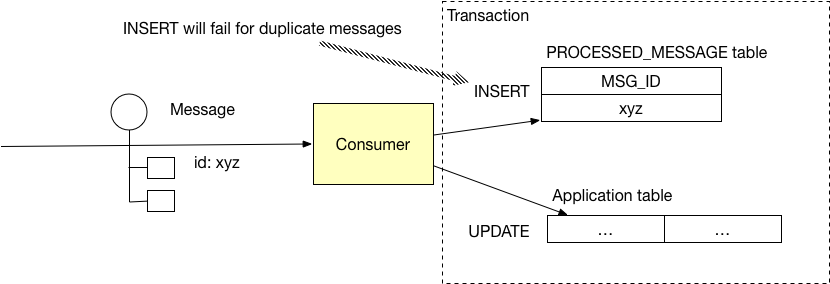
The diagram shows duplicate detection through a processed-message table: a repeated message ID makes the insert fail. section 8.3.7
Eventuate’s MessageConsumer implements the pattern, while its MessageProducer uses the transaction outbox for sending. These are distinct responsibilities in the messaging flow. section 8.3.10
