A pattern is a reusable solution to a problem in a particular context. In software, it solves an architectural or design problem by defining collaborating software elements. section 7.6.1
Patterns support deliberative design by offering candidate solutions and helping clarify the context and criteria used to evaluate them. This is especially useful when designing a complicated architecture such as microservices. section 7.6
Banking overdraft policies
An account that supports different overdraft limits and fees can use the Strategy pattern: an Overdraft interface encapsulates the algorithm, concrete strategies define particular policies, and Account uses the algorithm. section 7.6.1
Figure 7.11 The visual representation of different types of relationships between the patterns: a successor pattern solves a problem created by applying the predecessor pattern; two or more patterns can be alternative solutions to the same problem; one pattern can be a specialization of another pattern; and patterns that solve problems in the same area can be grouped, or generalized.
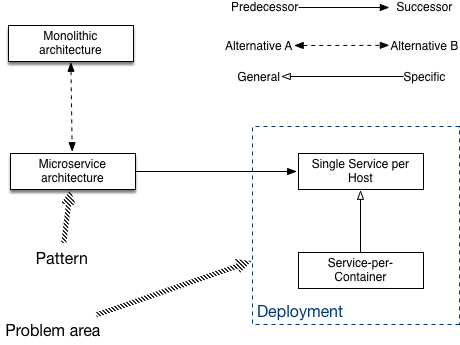
Explore how patterns can relate as alternatives, successors, specializations, or members of a generalized group. section 7.6.1
