An illicit Bitcoin transaction is a transaction associated with unlawful activity or the movement of illegally obtained funds. In anti-money-laundering work, the goal is to distinguish it from licit activity despite Bitcoin’s instant, borderless, pseudonymous payment flows. Laundering commonly moves through placement, layering, and integration; layering is especially difficult to trace because funds pass through a mesh of entities and transactions. section 9.0
Figure 9.1 Money laundering cycle, where illegally earned money is placed into the legal financial system via particular businesses such as laundromats, clubs, real estate, and so on. This money is then layered through a complex mesh of transactions into different financial entities, making it difficult to trace origins and identities associated with the laundered money. This money is then integrated into mainstream economy via clean investments into luxury assets, and different industrial and commercial entities.
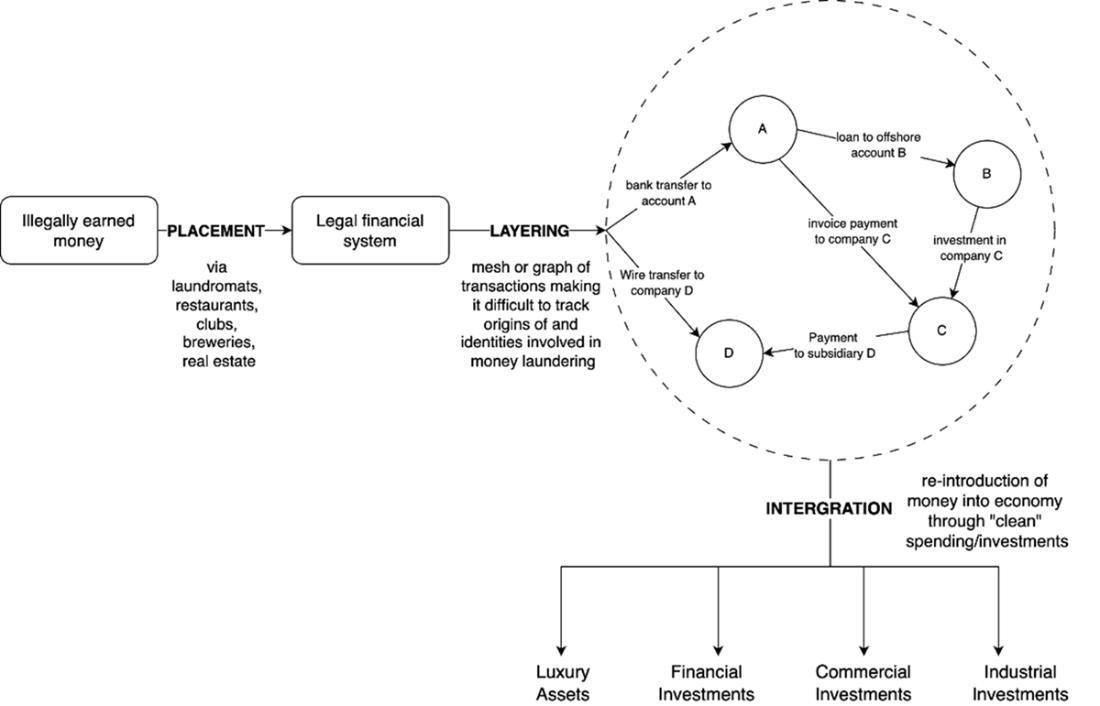
Follow the laundering cycle from entry into the financial system, through obscuring transfers, to apparently clean investments. section 9.0
In the Elliptic Bitcoin graph, each transaction is a node with 165 features and each directed edge represents a payment flow. Local features cover items such as timestamps, inputs, outputs, fees, and aggregate amounts; additional features summarize one-hop neighboring transactions. Labels separate licit and illicit classes, while many transactions are neither class. Because illicit nodes can connect to both licit and illicit neighbors, detection can use either transaction features alone or graph structure. section 9.1.2 section 9.1.4
A practical detection progression is:
- Establish an MLP baseline that classifies each transaction from its 165 features, ignoring payment-flow edges. section 9.2.1
- Train with cross-entropy and Adam, then evaluate both accuracy and weighted F1 because the classes are imbalanced. section 9.2.3
- Use a GCN to incorporate graph relationships, then compare a GAT model as a further graph-learning approach. section 9.3 section 9.4
Feature-only baseline
A two-layer MLP maps 165 transaction features to two outputs: licit and illicit. Its first layer produces eight intermediate features, followed by ReLU and dropout; the second produces class scores. Train it on labeled nodes, reserve held-out nodes for testing, and treat its results as the baseline before adding graph connectivity. section 9.2.1 section 9.2.3