A legitimate transaction is a licit financial transaction that is neither fraudulent nor associated with illicit activity. In Bitcoin anti-money-laundering analysis, it serves as the non-illicit class in a binary classifier designed to detect illicit transactions. section 9.1.2
Treat a legitimate transaction as a graph-learning data point with these characteristics:
- Represent it as a transaction node with 165 features, including local metadata and one-hop neighborhood aggregates such as fees, inputs, outputs, and transaction statistics. section 9.1.2
- Connect it to other transactions through directed edges representing payment flows between senders and receivers. section 9.1.2
- Expect legitimate transactions to outnumber illicit transactions, making accuracy alone insufficient for evaluating detection performance. section 9.1.4 section 9.2.3
Feature-only classification baseline
An MLP can classify transactions using only their 165 individual features, without using graph relationships. Training uses cross-entropy loss and Adam optimization; evaluation converts predictions to binary labels and reports accuracy alongside weighted F1. The resulting baseline reaches 93.28% accuracy and a 93.77% F-score on the test set. section 9.2.3
Figure 9.6 Visualization of the validation set transactions of the Bitcoin dataset, showing coded licit and illicit transactions, connected via directed edges.
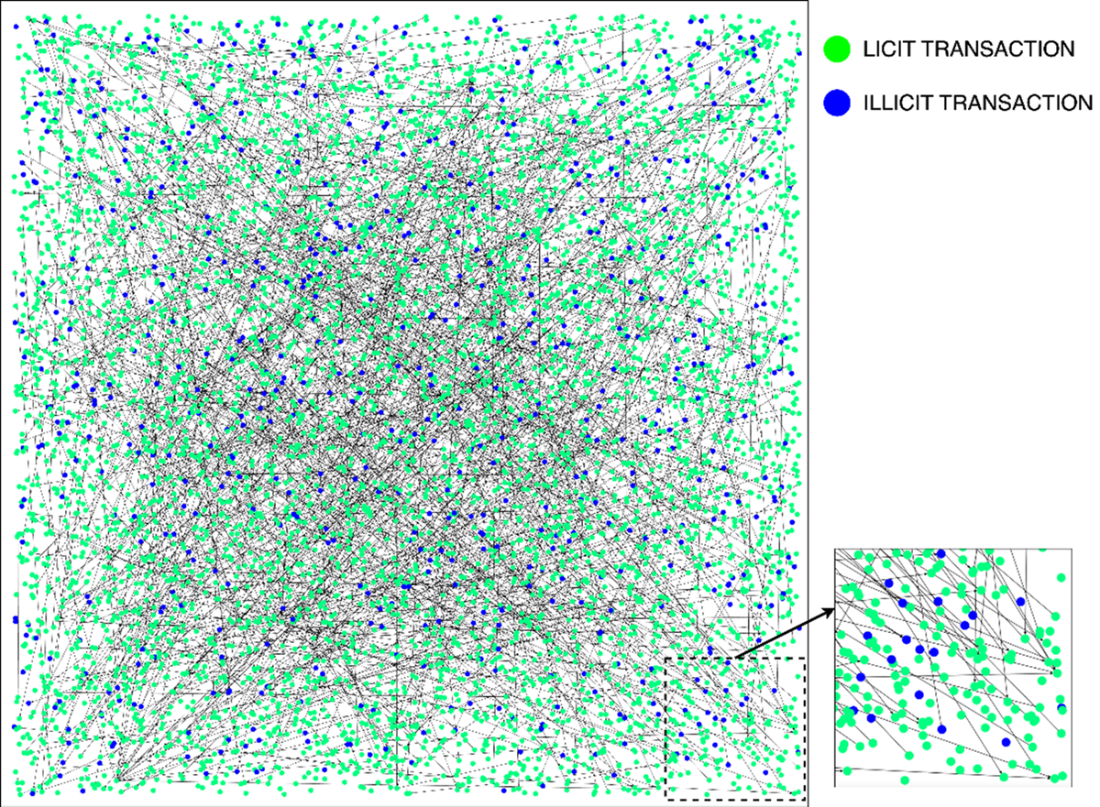
Inspect the validation graph to see legitimate and illicit transaction nodes connected by directed payment-flow edges. section 9.1.4
