Image segmentation labels the exact pixels belonging to an object or region. Choosing it is a product decision: pixel-level outputs require different tools, expertise, time, and models than image-level or region-level labels. section 3.1 section 6.2.4
Choose segmentation deliberately by checking:
- Whether the product needs the exact shape and boundaries of a target rather than its presence or a surrounding region. section 6.2.4
- Whether the labeling team can provide sufficiently detailed annotations, given available experts, time, interfaces, and quality-control processes. section 6.2.4
- Whether partial or inaccurate labels justify considering weakly supervised learning when precise annotation is impractical. section 6.2.4
- Whether a comparable solution matches both the business domain and technical requirements such as latency, platform, data model, and volume. section 3.1
Fine-grained manufacturing inspection
An assembly-line system needed subpixel-accurate outputs to locate extremely small components. Because manufacturing examples were scarce, image-matting techniques from medical analysis and photo or video editing provided useful ideas. Hair segmentation illustrates the difficulty: separating hair from a background can require avoiding downsampling and using soft labels that assign pixels weighted foreground and background membership. section 3.1 section 3.1
Figure 6.2 Various approaches to data labeling
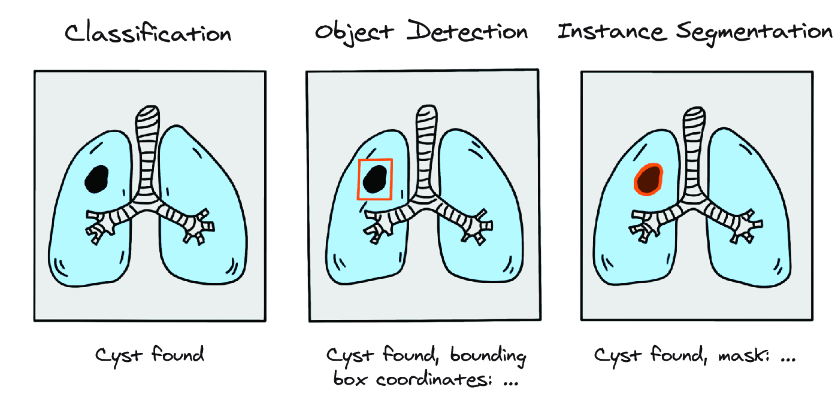
Compare binary classification, multiclass classification, detection, and segmentation to see how annotation granularity changes the available product and model choices. section 6.2.4





