Image segmentation is a dense prediction task: it labels each pixel, for example as road, car, or dog, to outline objects and surfaces. Unlike image classification, it must preserve fine spatial detail. Pooling and strided convolutions can erase edges and location cues, so they are less suitable for precise pixel labeling. section 3.5
In 2015, Fisher Yu and Vladlen Koltun introduced dilated convolutions to expand a model’s receptive field without pooling or reducing resolution. Inserting gaps between kernel elements grows the field while keeping the parameter count unchanged, offering a way to capture broader context without sacrificing spatial fidelity. section 3.5
Figure 3.7 Semantic segmentations produced by different segmentation models. From left to right: the first column is the input image, the second is the prediction by FCN-8s, the third is the prediction by DeepLab, the fourth is the prediction by Yu and Koltun (2015), and the last is the ground truth. The examples illustrate progressively more precise and accurate segmentations, with the method of Yu and Koltun (2015) significantly improving boundary definition and object identification compared to previous methods. Used with permission granted by the lead author (Fisher Yu).
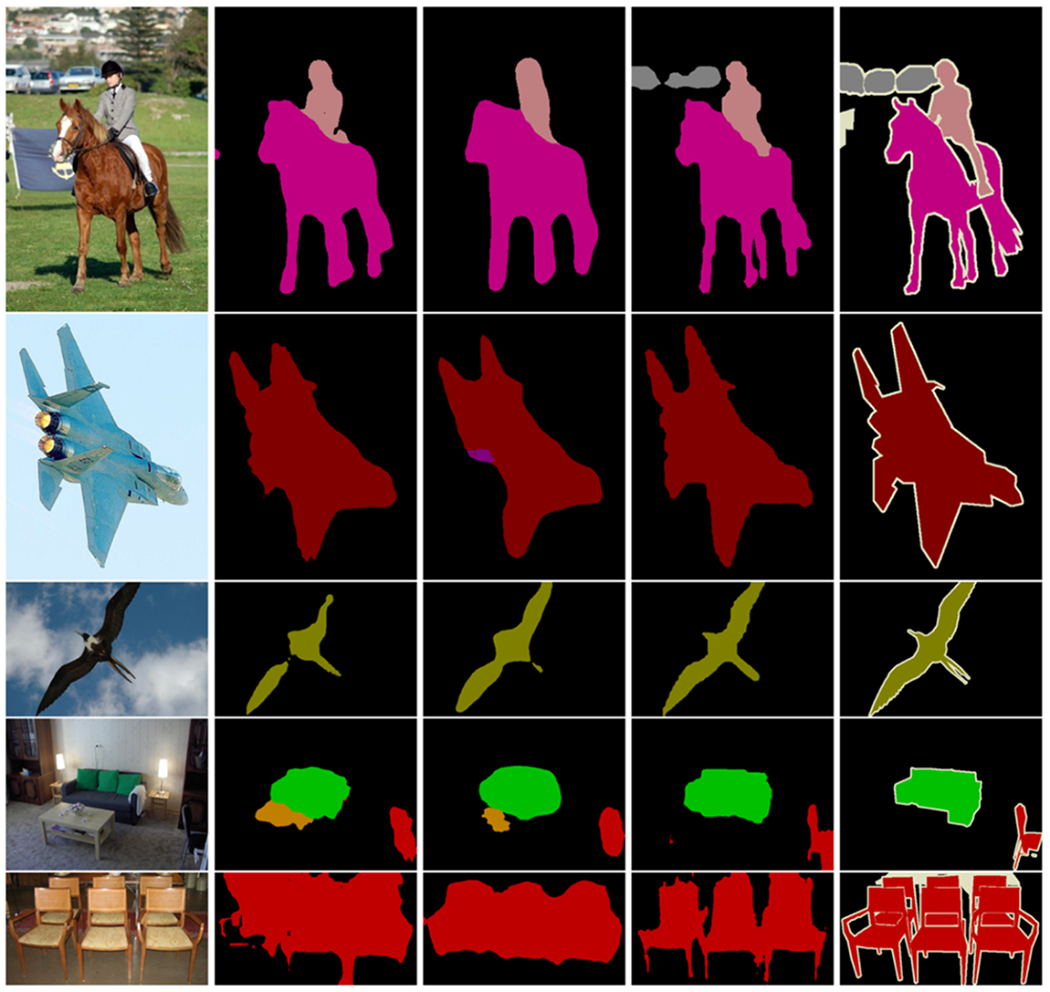
Compare predictions from FCN-8s, DeepLab, and Yu and Koltun’s method with the input and ground truth; the figure highlights improvements in boundaries and object identification. section 3.5





