liveBook · Manning

Impact

As explained in Data-Driven Cybersecurity

Impact is the potential damage or adverse consequence resulting from a threat exploiting a vulnerability.

Impact is the possible damage when a threat actor exploits a vulnerability. Risk is calculated as likelihood × impact; both values can be assessed qualitatively or quantitatively. section 6.3.1

Risk depends on both dimensions: medium likelihood with high impact can yield high risk, as can critical likelihood with negligible impact. Low likelihood and low impact can yield negligible risk. Choose a matrix suited to organizational needs and context. section 6.3.1

Figure 6.4 Visualizing threat likelihood and impact for effective risk management
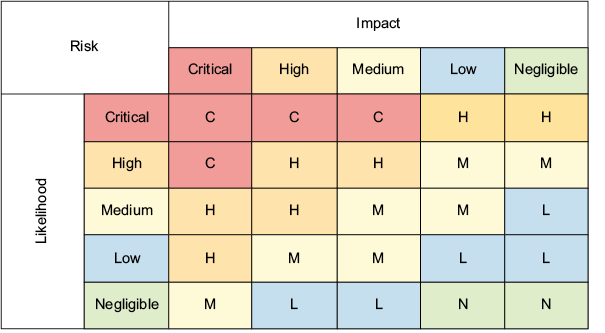
Use the likelihood-and-impact visualization to compare risk levels. section 6.3.1

How Data-Driven Cybersecurity covers it

How deep it goes
Defines impact as possible damage and compares qualitative judgment with quantitative analysis without prescribing one measurement method.
Examples
Compares medium likelihood with high impact, critical likelihood with negligible impact, and low likelihood with low impact.
What you can do after
Evaluate risk by combining likelihood and impact, then choose a matrix suited to organizational context.
How it connects
Links impact to threats, vulnerabilities, likelihood, risk assessment, and risk matrices.

Related concepts

This explainer was generated by Manning's knowledge graph from the text of Data-Driven Cybersecurity. The section links point to the parts of the book it draws on.