An implicit equation describes a geometric object by stating which points satisfy an equation or system of equations. Unlike an explicit formula, it does not construct the object one point at a time. section 2.3.1 section 10.1.1
Use the representation that matches the geometry:
- In 2D, the general implicit form describes every line, including vertical lines that cannot be written as y = f(x). section 2.3.1
- In 3D, adding another scaled variable turns the analogous general equation into a plane; a 3D line needs a system of equations or another representation. section 2.3.1 section 2.3.3
- For shape modeling, implicit formulas identify inside and outside regions; signed distance functions add true distance information when operations such as offsets matter. section 10.1.1
A circle without solving for y
The equation x² + y² = r² describes every point on a circle centered at (0, 0) with radius r. It models the same circle as a distance-based formula, but it does not return y as an explicit function of x. Replacing true distance with a simpler expression can preserve the circle while losing signed-distance properties. section 10.1.1
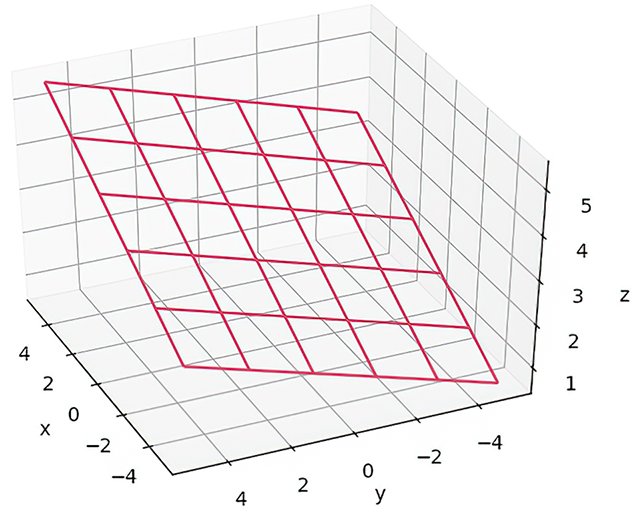
Compare the explicit and implicit forms of a plane and see why the same algebraic pattern changes geometric meaning in 3D. section 2.3.1
Figure 10.3 An SDF of a circle (left) and an equivalent model that isn’t an SDF (right). Both functions model the same circle.

See how a true signed distance function and a non-distance implicit model can describe the same circle while supporting different operations. section 10.1.1
