An importance matrix is generated by running a small calibration corpus through the model. It steers codebook fitting toward weights that matter most for output quality. section 10.2.1
It can improve both IQ-quant and k-quant fitting. At sub-4-bit budgets, codebook fitting is too lossy without calibration, making the matrix practically inseparable from IQ-quants. section 10.2.1
Figure 10.2 GGUF quantization formats by bits per weight, including per-block scale and metadata overhead. Legacy quants (dotted) span Q4_0 (4.50 bpw) through Q8_0 (8.50). K-quants (diagonal) span Q2_K (2.62) through Q6_K (6.56). Bars show each base format's bpw; the recipe-level M-variants (Q3_K_M, Q4_K_M, Q5_K_M) sit 0.2–0.4 bpw above their base because of bumped tensors, as 10.2.4 makes explicit. IQ-quants (cross) span IQ1_S (1.56) through IQ4_XS (4.25). Importance-matrix calibration pushes below the k-quant floor. Reference dashes mark INT4 and INT8.
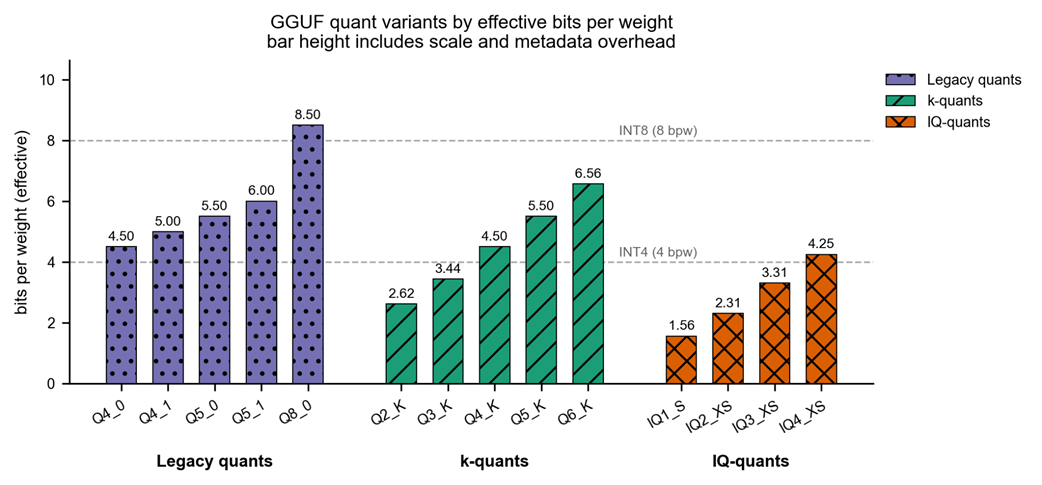
Compare quantization formats by bits per weight; the chart notes that importance-matrix calibration enables formats below the k-quant floor. section 10.2.1
