Mutation makes a small random change to an offspring candidate in an evolutionary algorithm. Think of offspring that resemble their parents but are not exact copies: the change gives the population another possibility to try. Crossover mixes genes from parents; mutation changes an offspring after that mixing. section 4.1 section 4.11
Mutation helps preserve diversity, which can keep a search from getting stuck at a locally best solution. Its method depends on how candidates are encoded. The mutation rate controls how likely mutation is, but more is not always better: excessive change can damage good solutions. section 4.14 section 4.20
Flip one bit
Suppose an offspring has a binary chromosome such as 1011. Select one gene position at random. If it holds 1, change it to 0; if it holds 0, change it to 1. Selecting the second position turns 1011 into 1111. The candidate differs by just one bit, so it can be evaluated alongside other offspring. section 4.15 section 5.1
Figure 4.23 Bit-string mutation
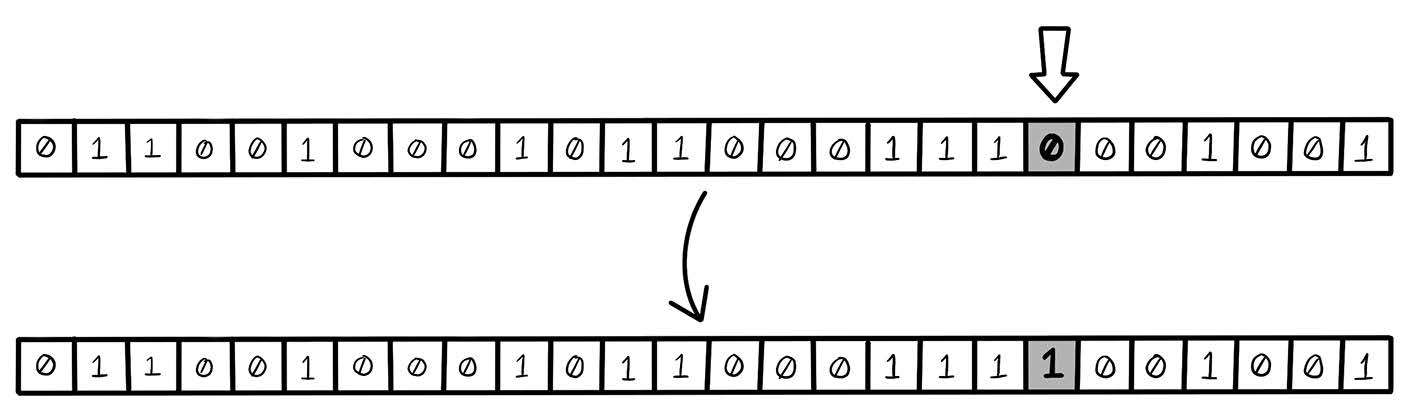
The bit-string diagram shows the small change made to a binary-encoded chromosome. section 4.15
Choose a mutation method that still produces valid candidates. Binary bit-flipping is one method, not a rule for every problem; other encodings need other changes. A practical genetic-algorithm cycle evaluates candidates, selects parents, creates varied offspring, and chooses which individuals continue to the next generation. section 4.20 section 5.1











