An incumbent is the best result observed so far during optimization: the queried point with the highest objective value. It is not merely better than one previous trial; it must clear the highest bar set by every observation already made. Each newly evaluated point can either replace that bar or leave it unchanged. section 4.2.1
A moving target for improvement
Suppose x0 has objective value 20, x1 has 18, and x2 has 19. Although x2 is better than x1, neither improves on x0, so x0 remains the incumbent. A later point x3 with value 21 becomes the new incumbent. This distinction turns optimization progress into a comparison against one current threshold rather than against arbitrary earlier points. section 4.2.1
In Gaussian-process Bayesian optimization, the incumbent value defines what counts as useful upside. Draw it as a horizontal line through the best observed value: only predicted outcomes above that line are improvements. At a candidate location, the model's predictive distribution may place much or little probability above the threshold, even when the actual objective value is still unknown. section 4.2.1
Figure 4.8 Improvement from the incumbent from the perspective of a GP. The portion of the GP’s predictions that corresponds to improvement from the incumbent is highlighted in a darker shade.
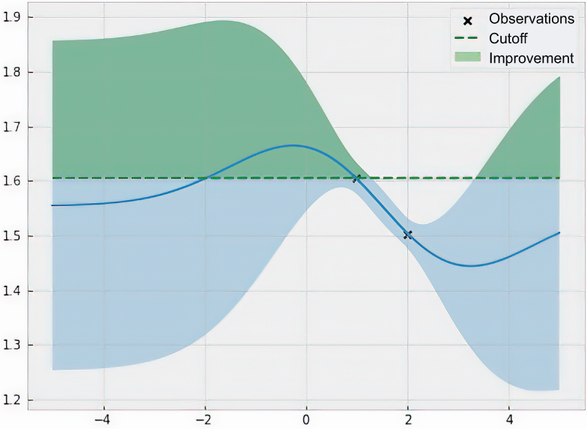
The shaded region makes the incumbent concrete: predicted function values above its horizontal level represent possible optimization improvement. section 4.2.1
Probability of Improvement (PoI) scores a candidate by the chance that its predicted function value exceeds the incumbent. With a normal predictive distribution, that chance is the area above the incumbent threshold, computed from the distribution's mean and standard deviation. The candidate with the highest PoI can then be selected for the next evaluation. section 4.2.2
The incumbent also exposes an exploration trade-off:
- Accepting any positive improvement can make PoI repeatedly sample near a local optimum, where marginal gains seem likely. section 4.2.3
- Raising the required threshold to incumbent value plus ε makes only sufficiently large gains count, encouraging searches elsewhere. section 4.2.3 section 4.4.1
- Choosing ε matters: a fixed threshold can be tested at several values, or set as a percentage increase over the incumbent. section 4.4.1
Constraints change which observations are eligible to lead. In constrained optimization, the feasible incumbent is the highest objective value among observations satisfying the constraint; infeasible points are filtered out before taking the maximum. If no feasible point has appeared, progress tracking can use a chosen default value until one does. section 8.4
Tracking progress across repeated runs
To compare Bayesian-optimization policies fairly, repeat runs from different starting data and record the incumbent value at every iteration. Averaging those trajectories with error bars summarizes how quickly policies find stronger observed results, rather than relying on one potentially misleading run. section 4.4.2
