Suppose a temperature model is trained in Kathmandu and used to reason about El Paso. The distribution of cloud cover may differ, but the physical mechanism relating altitude, cloud cover, latitude, and season to temperature may remain the same. Independence of mechanism is the assumption that changing one causal mechanism does not, by itself, change a distinct mechanism. Transfer still requires a correct causal model and enough training data to learn the mechanism that is meant to transfer. section 3.2.1 section 3.2.2
In a causal DAG, each child node has a causal Markov kernel describing how its parents determine it. For C → O, P(O|C) represents the cause-to-outcome mechanism, while P(C) describes how often causes occur. Learning how sunscreen use affects sunburn does not tell you how common sunscreen use is. By contrast, reasoning backward from a sunburn to possible sunscreen use depends on prevalence: P(C|O) is not itself the cause-to-outcome mechanism. section 3.5 section 5.3.1
The distinction has practical consequences:
- Parameter modularity: separate kernels encode separate mechanisms, so their representations can be changed or trained separately. Their parameter sets can have independent priors, although they are generally dependent in the posterior. section 3.2.1
- Causal transfer learning, data fusion, and invariant prediction can exploit a mechanism that remains stable when other parts of a system change; that stability must be justified for the domains involved. section 3.2.2
- In semi-supervised learning, unlabeled features reveal information about P(X), but not directly about P(Y|X). Whether they help predict labels depends in part on the causal direction between features and labels. section 5.3.1 section 5.3.2
A labeling decision
A social-media image classifier may have many unlabeled images but few human-labeled examples of gratuitous violence. Before expecting the extra images to improve label prediction, ask what their distribution teaches about the joint model of images and labels. Independence of mechanism makes this a causal-direction question, not simply a question of how many unlabeled images are available. section 5.3.2
Figure 5.16 In causal learning, the features cause the label. In anti-causal learning, the label causes the features.
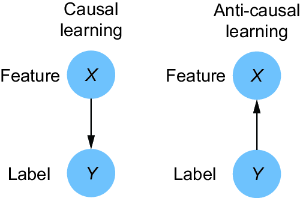
Compare features causing labels with labels causing features when assessing whether unlabeled features could improve prediction. section 5.3.2
