Parameter modularity separates parameters for distinct causal mechanisms. Changing the representation of one causal Markov kernel does not require changing the representations of others, unlike ordinary statistical models where components often remain coupled. section 3.2.1
A causal DAG makes this separation operational: each child node has a causal Markov kernel conditioned on its parents, and its parameter set encodes that mechanism. Training can therefore optimize kernel-specific parameter sets separately or as decoupled groups, reducing dimensionality and supporting independent prior distributions. section 3.2.1 section 3.5
Temperature DAG
Represent the temperature mechanism P(T | A, C, L, S) separately from the cloud-cover mechanism P(C). Updating one representation can leave the other unchanged, reflecting their distinct physical causes rather than an arbitrary statistical factorization. section 3.2.1
The same property constrains information flow in semi-supervised learning. When Y causes X, as with handwritten-digit labels generating images, unlabeled X can improve P(X) or P(X | Y), which can inform P(Y | X) through Bayes rule. When X causes Y, parameter modularity isolates P(Y | X), so unlabeled X updates P(X) without directly updating the predictive mechanism. section 5.3.2
Figure 5.16 In causal learning, the features cause the label. In anti-causal learning, the label causes the features.
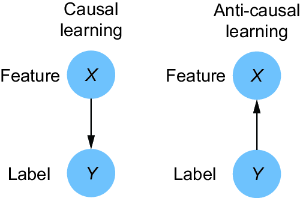
Use the causal-versus-anti-causal diagram to track which variable causes the other and which parameter representation unlabeled observations can update. section 5.3.2
