Independent deployment lets a team build, test, and release a service without releasing other services. It is more than packaging code separately: the service needs its own deployment pipeline and must be production-ready after testing in isolation. This reduces release coordination and helps teams deliver changes quickly. section 1.3.1 section 7.3.1
An independently deployable service has three essential properties:
- It is a deployable unit, such as an executable JAR, container image, operating system executable, or ZIP containing an AWS Lambda function. A library that must be packaged with other libraries is not enough. section 7.3.1
- It has its own pipeline to build, test, and deploy it. A shared pipeline can require team coordination and let one service’s failed tests block another’s release. section 7.3.1
- It can be considered production-ready after tests run in isolation, rather than depending on end-to-end tests involving other services. section 1.3.1 section 7.3.1
Loose design-time coupling supports independent deployment: a change to one service should rarely require a change to another. Without independent deployment and loose coupling, a system risks becoming a distributed monolith, combining distributed-system complexity with coordinated-release friction. section 1.3.1 section 7.3
Application-level acceptance tests can undermine independence when they span services. Replace them with service-level acceptance tests that exercise each service in isolation, using knowledge of how services collaborate. If services cannot be tested independently, improve the architecture or consider a monolith instead. section 7.5.5
Figure 7.10 Acceptance tests that span multiple services and would be end-to-end tests must be refactored to service-level acceptance tests that test each service in isolation.
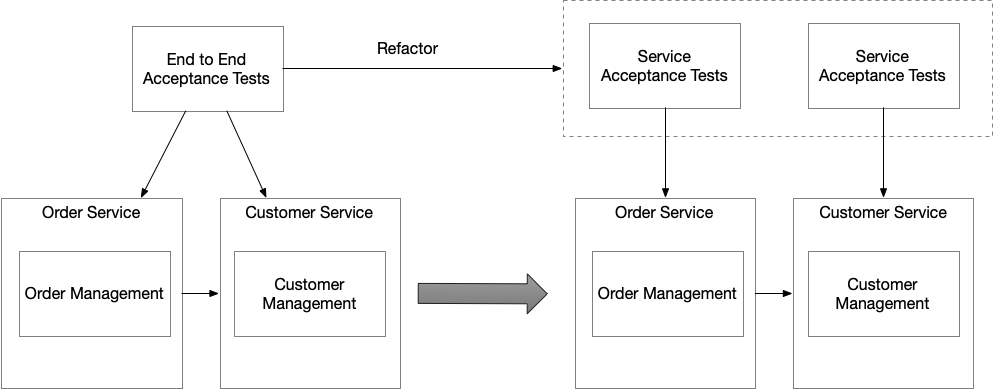
The diagram contrasts cross-service acceptance tests with tests run separately for each service. section 7.5.5
Sequencing an API change
Suppose an Order Service needs the Consumer Service’s reserveCredit() response to include available credit. Existing clients can ignore the new property, but the updated Consumer Service must be deployed before the Order Service uses it. For a breaking change, introduce a new API version alongside the old one, migrate clients, then remove the old version. Independent pipelines do not eliminate coordination for changes spanning services. section 7.5.2
Separate services can also isolate critical functionality on highly available infrastructure, or use different technology stacks and upgrade them incrementally. These benefits come with costs: operations spanning services must handle network failures, latency, availability, and transaction boundaries. Use independent deployment where its delivery and isolation benefits justify that complexity. section 1.3.3 section 1.3.4

