External index fragmentation occurs when an index’s pages are physically out of logical sequence. A page split in the middle of an index can create this disorder: SQL Server allocates a new page, moves rows, and updates page pointers. The result adds I/O and can degrade performance. section 9.2 section 11.1
Figure 9.2 Bad page split
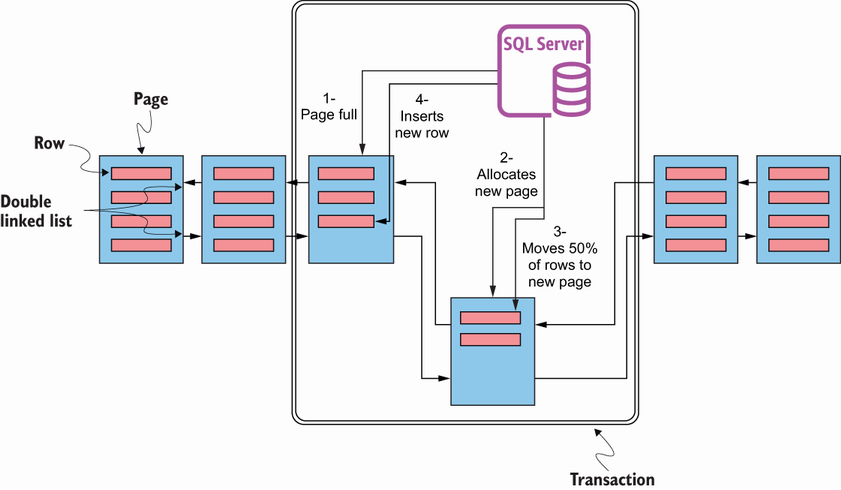
Compare a middle-of-index page split with an end-of-index allocation: the former leaves the new page out of order and creates external fragmentation. section 9.2
Do not treat fragmentation as the first explanation for every slow query. Physical page order matters to an index scan, which reads leaf-level pages in sequence; an index seek traverses the B-tree to find a row and is not affected by external fragmentation. Queries returning a scalar or one row are therefore unlikely to benefit from an emergency rebuild. section 11.12 section 11.2
Diagnose before scheduling maintenance:
- Measure external fragmentation with avg_fragmentation_in_percent and page density with avg_page_space_used_in_percent from sys.dm_db_index_physical_stats. section 11.3
- Check seek, scan, and lookup usage through sys.dm_db_index_usage_stats; prioritize fragmentation where scan activity makes it relevant. section 11.12 section 11.2
- Inspect leaf-level data rather than aggregating fragmentation statistics across index levels. section 11.12
After shrinking a data file
Purging old archive data and shrinking its data files may reclaim space but can fragment indexes, causing slower user queries after maintenance. Take a fragmentation baseline, shrink only when necessary, then rebuild affected indexes. Do not rely on autogrow to manage database size. section 9.2 section 9.12
Rebuilding creates a new B-tree and nearly removes fragmentation, but costs more resources. Reorganizing has lower cost and attempts to reorder leaf pages, yet it can leave pages full; subsequent inserts may quickly cause more bad page splits. Select rebuilds from measured need instead of rebuilding every index indiscriminately. section 11.3 section 11.12
