Recommender systems infer preferences from behavior—such as what people like or interact with—instead of asking them to list what they want. A social-media feed might prioritize newer posts and friends a user interacts with often. section 1.2.2
A feedback loop in the feed
Seeing a friend’s updates more often can create more chances to message them; those interactions may then help the system infer that their posts matter to you. section 1.2.2
Figure 1.3 Various social media models. In the Subscription model, the content is seen only by users who explicitly follow the content producer, with no options or resharing. In the Network model, users can also reshare content from users they follow, enabling the distribution of content outside of the immediate network. Finally, in the Algorithmic model, an algorithm can add content to users’ feeds, even with no direct connection to the content itself or its author.
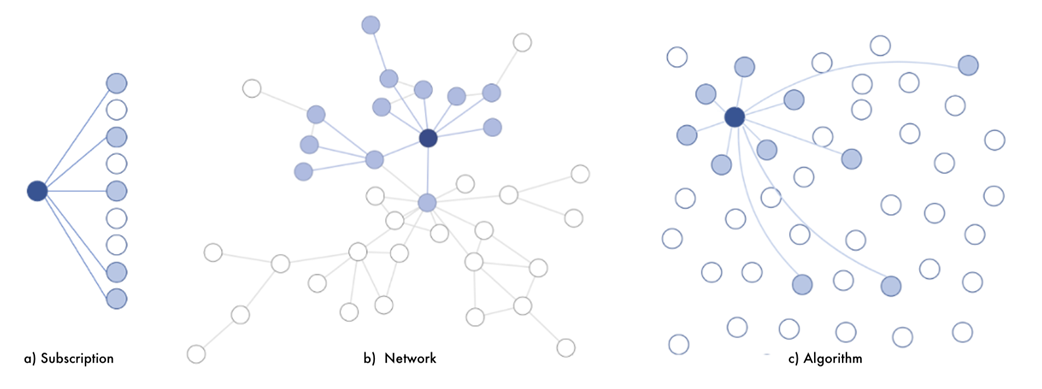
Compare subscription, network, and algorithmic feeds: algorithmic feeds can include content even without a direct connection to its author. section 1.2.2
