Industry Foundation Classes (IFC) is an ISO standard and the primary open file format for exchanging building information modeling (BIM) data. An IFC file represents both building geometry and the meaning of its elements: a wall is identifiable as a wall and can carry properties and relationships to spaces and systems. It is more than a 3D picture. section 2.4.2
Figure 2.9 An example of a BIM model in IFC, showing the 3D model and additional information stored within it. © Viktor Kovacs. Data licensed under MIT.
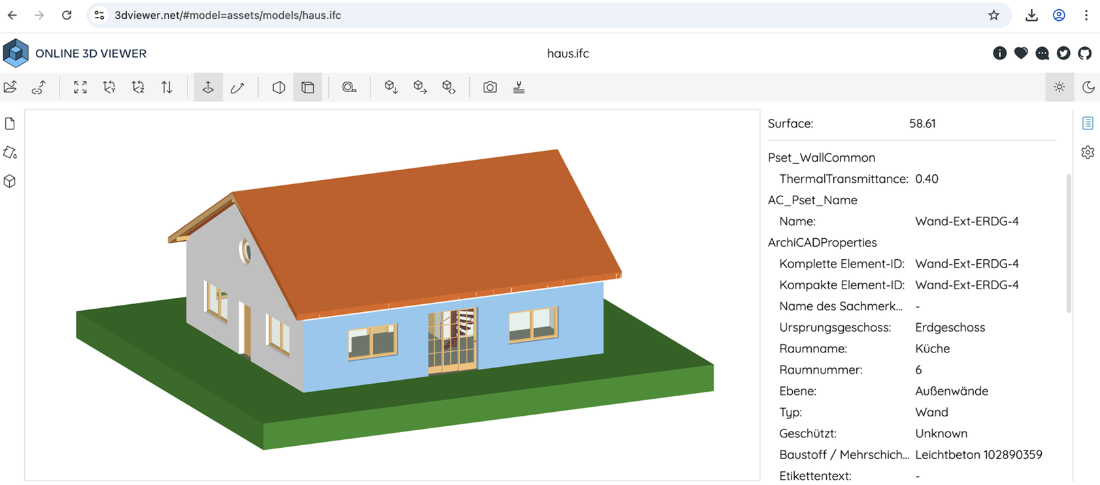
The IFC model shows the distinction directly: select a wall to inspect its properties alongside its position in the 3D building. section 2.4.2
In a digital twin, IFC acts as a data model standard for construction, helping information from different systems retain consistent meaning. It occupies a different layer from communication protocols such as MQTT and OPC UA, which govern how data moves. section 5.5.1
To connect a sensor reading or maintenance record to a particular valve or HVAC unit, map the external record to the model element using an IFC globally unique identifier (GUID). Do not assume the match will be automatic: missing identifiers, naming differences, and inconsistent schemas can require manual reconciliation or bespoke middleware. section 7.3.2
