Inference-time compute scaling improves a trained model’s answer quality by spending more computation per question without changing its weights. It trades higher accuracy for longer runtime, greater compute use, and often higher API cost. section 4.1 section 4.3
Use three complementary inference-time strategies:
- Extend the response with chain-of-thought prompting, such as “Explain step by step,” so the model writes intermediate reasoning before its final answer. section 4.1 section 4.3
- Generate multiple candidate answers with temperature and top-p sampling, then use self-consistency to select the most frequent final result. section 4.7 section 4.4
- Iteratively critique and improve one answer through self-refinement, using scoring signals such as token log probabilities to track progress. section 5.0 section 5.1
Solving a MATH-500 equation
A base model initially produces the wrong result for “Half the value of 3x−9 is x+37.” Adding “Explain step by step” elicits intermediate algebra and changes the final answer to 83. The longer response improves reasoning but requires more generated tokens. section 4.2 section 4.3
Figure 4.1 A model of the topics covered in this book. This chapter focuses on inference-time-scaling techniques, which improve reasoning without additional training (stage 3). In particular, it extends the text generation function and implements a voting-based method to improve answer accuracy. The next chapter will introduce another inference-time-scaling approach where the model iteratively refines its own answers.
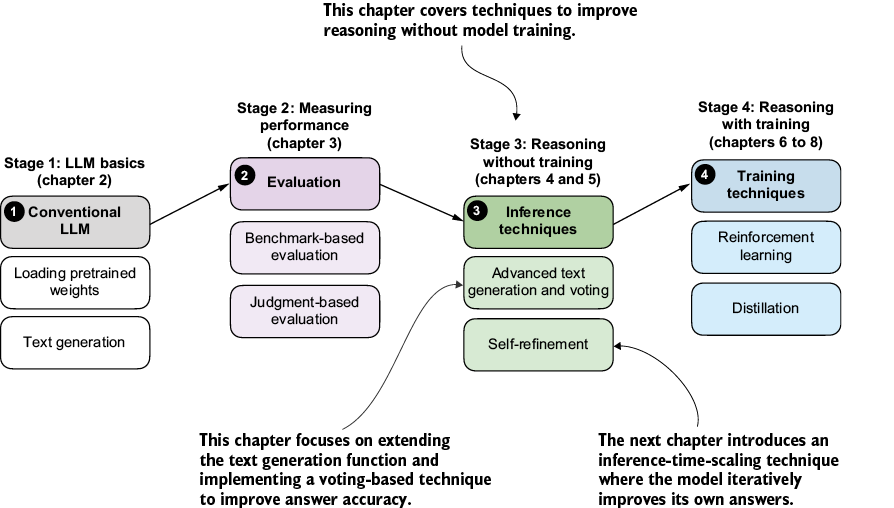
Use the workflow to distinguish prompt extension, voting over sampled answers, and iterative self-refinement within the inference stage. section 4.0



