Inference-time compute scaling, or test-time scaling, improves downstream performance by spending more computation while generating an answer. A model may generate a longer reasoning chain, sample several candidate responses, or make additional inference calls rather than committing to its first output. The technique matters when extra tokens or rollouts produce better task performance rather than merely consuming energy. section 7.0 section 7.2.2
Reasoning-trained models are especially associated with this behavior. Reinforcement learning with verifiable rewards (RLVR) can elicit reasoning that uses more generated tokens, and longer reasoning chains are strongly correlated with improved results on verifiable downstream tasks. This differs from early RLHF length bias: increasing response length for small preference-ranking gains is not itself useful scaling. The operational test is whether added inference compute improves the final answer. section 7.2.2 section 7.5
Common ways to allocate extra inference compute include:
- Generate a longer reasoning process before producing the answer. section 7.0
- Sample repeated responses and extract an answer from the resulting candidates. section 7.2.2
- Run parallel, independently sampled rollouts and return the majority answer. section 7.3.3
- Score parallel candidates with a selection model and choose the best answer rather than relying on a vote. section 7.3.3
- Use value-guided sampling or compose additional inference calls to search more deliberately. section 7.2.2
Parallel rollout selection
For a question with a verifiable answer, sample several independent reasoning rollouts. A basic pipeline extracts each final answer and returns the majority result. A more advanced pipeline sends the candidate answers to a scoring model, which selects the strongest one. Both pipelines spend more inference compute than a single rollout; the latter replaces agreement with learned selection. section 7.3.3
Compute budgets can also be controlled. Progressive length scheduling trains effective reasoning under a limited thinking budget before extending it to harder problems, helping limit overthinking. Some models expose reasoning-length controls through system prompts or low–medium–high settings. Distillation from a larger RL-trained model to a smaller one is another explored route, but the broader method landscape is evolving quickly. section 7.3.3 section 7.2.2
Evaluation must account for the inference budget. Since models can gain performance by using more tokens, comparing scores without controlling total inference tokens can confound model capability with compute allocation. Reproducible comparisons are further complicated by hidden prompts, tokens, evaluation configurations, and output-format sensitivity. section 16.2
Figure 7.1 RLVR in the form of an RL feedback loop. Instead of a reward model, a verification function is used.
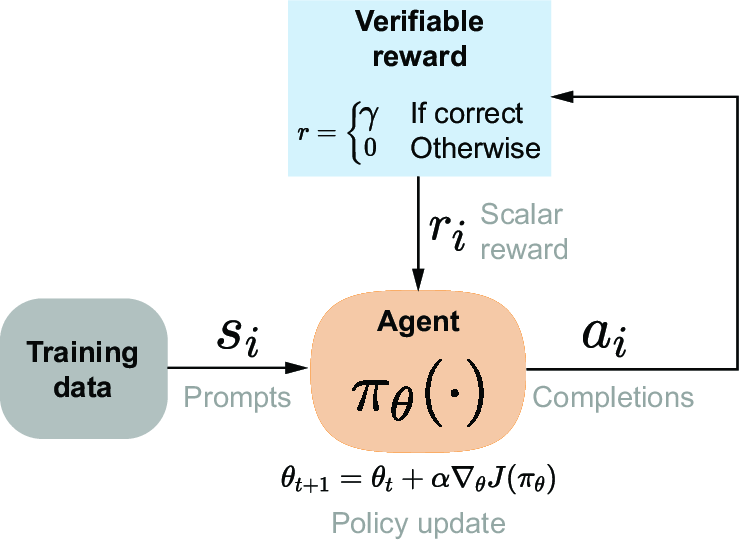
The RLVR feedback-loop diagram situates inference-time scaling beside the training process that commonly elicits reasoning behavior: verification functions replace a learned reward model. section 7.0



