An information extraction pipeline turns unstructured text into structured facts by identifying entities, resolving references, extracting relations, and producing triples. A triple contains a head, relation, and tail; together, triples can construct a graph. section 12.0
A practical pipeline commonly combines these stages:
- Coreference resolution connects pronouns and other references to the entities they describe. section 12.0
- Named entity recognition and linking identifies people, organizations, and other entities and connects mentions to entities. section 12.0
- Relation extraction identifies links between entities, such as a person founding a company or an organization acquiring another organization. section 12.0 section 12.4
- Graph construction converts extracted triples into nodes and relationships, while some facts may be stored as node properties. section 12.0
Extracting facts about Apple
From text about Apple Inc., the pipeline can produce triples such as Steve Jobs–FOUNDED–Apple, Steve Wozniak–FOUNDED–Apple, and Apple–FOUNDED_ON–April 1, 1976. The evaluation text also describes Apple’s first product, founders, financing, and acquisitions. section 12.0 section 12.4
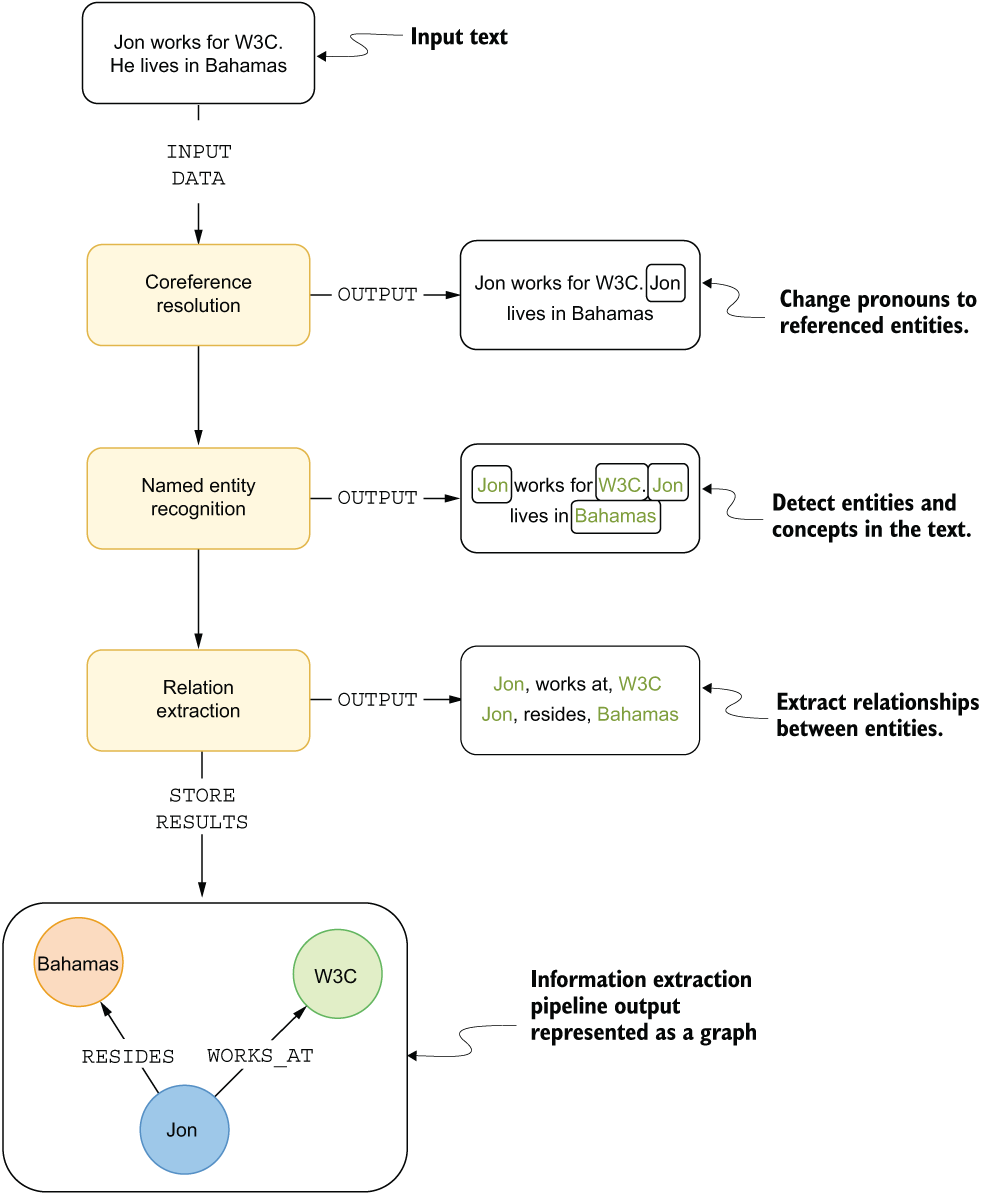
Use the pipeline design figure to follow how text becomes extracted information and then a graph. section 12.0
