Infrastructure configuration declaratively specifies the resources, properties, relationships, and metadata that make up an infrastructure system. Treating that specification as code communicates intended architecture and expected state, reducing reliance on individual memory and improving reliability. section 1.4.3 section 7.5
Build and maintain infrastructure configuration around these practices:
- Compose independent modules for networks, servers, load balancers, databases, and related resources so individual components can change without disturbing the whole system. section 1.3.3
- Share standardized modules across teams instead of copying unique configurations; allow teams to reproduce established designs and override details for local needs. section 5.0 section 5.1
- Test configuration and state statically for names, resource counts, address ranges, generated logic, insecure values, and organizational standards before production changes. section 6.2 section 6.2.3
- Review and deliver changes through version control, automated checks, testing environments, and suitable branching or trunk-based workflows. section 7.5 section 7.2.3
- Refactor oversized configurations into separate resources or repositories to reduce conflicts, feedback time, blast radius, and security risk without changing existing resources. section 10.0 section 10.1
A composable production environment
A secure hello-world.com environment combines a server, load balancer, private and public networks, routing rules, and a domain name. Replacing the standard load balancer with a premium module leaves the server and network running, while another team can add a database independently. section 1.3.3
Figure 1.9 You build your production environment with building blocks of infrastructure so you can add new resources, like the premium load balancer, easily.

Use the building-block figure to see how network, server, and load-balancer modules combine into a production environment and support low-impact replacement. section 1.3.3
Figure 5.1 Datacenter for Veggies can use modules to organize and standardize infrastructure configuration across application teams.
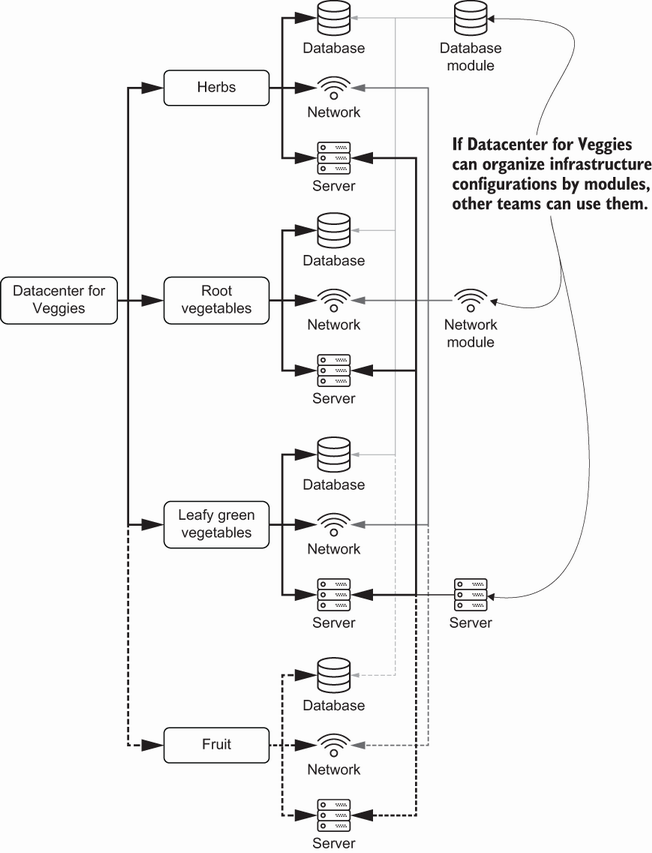
Use the cross-team figure to compare how standardized network, database, and server modules support reproducibility and composability across application teams. section 5.0





