liveBook · Manning

Inner product decoder

As explained in Graph Neural Networks in Action

An inner product decoder reconstructs pairwise graph connectivity by scoring pairs of latent node representations with their inner product and converting the scores into edge probabilities.

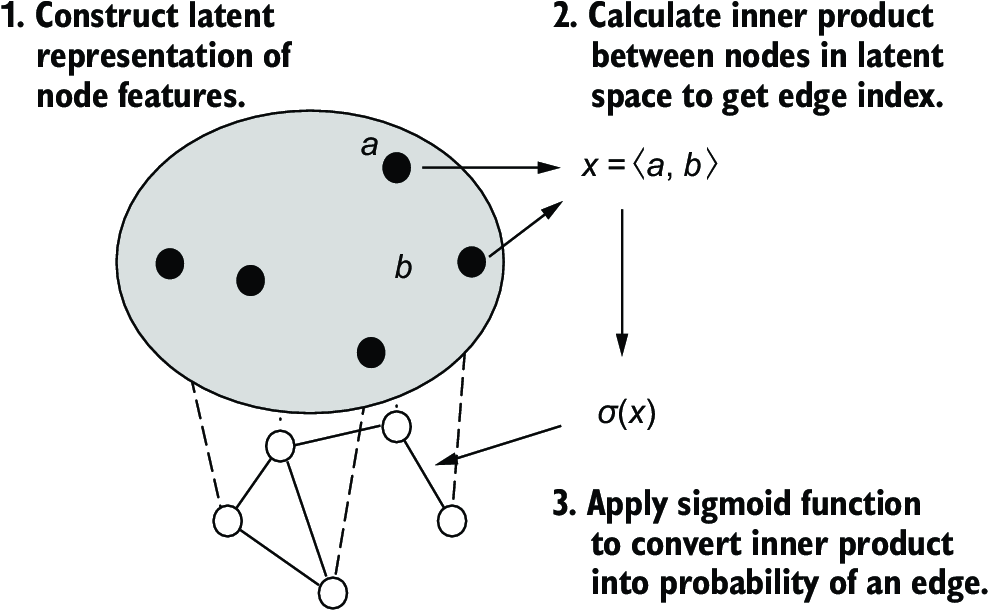
An inner product decoder reconstructs graph connectivity from latent node representations. It scores node pairs by their inner product, rescales each score with sigmoid, and interprets the result as an edge probability. section 5.5.2

Use the decoder as a short link-prediction pipeline:

  • Take the latent representation produced for each node. section 5.5.2
  • Select node pairs through the graph’s passed edge index and calculate their inner products. section 5.5.2
  • Apply the sigmoid function to convert scores into a matrix of edge probabilities. section 5.5.2

Link prediction

Given latent positions for nodes, decode each selected pair into a probability that an edge exists, thereby reconstructing the adjacency structure. section 5.5.2

Figure 5.17 Overall steps for training our model for link prediction
figure

Use the training-pipeline figure to trace latent representations through decoding and link prediction. section 5.5.2

How Graph Neural Networks in Action covers it

How deep it goes
Explains pairwise inner products, edge-index selection, sigmoid conversion, and probability-matrix output.
Examples
Uses latent node positions and selected node pairs to demonstrate adjacency reconstruction and edge-probability decoding.
What it assumes
Assumes latent node representations and graph edge indices; explains how those inputs become edge probabilities.
What you can do after
Apply it to decode node pairs into probabilities indicating whether graph edges exist.
How it connects
Connects graph autoencoders, latent representations, adjacency matrices, sigmoid functions, and link prediction.

Related concepts

This explainer was generated by Manning's knowledge graph from the text of Graph Neural Networks in Action. The section links point to the parts of the book it draws on.