An input space is the set of possible values supplied to a model or mathematical function. A model generalizes reliably only across regions of this space represented by its training data; unfamiliar regions can make its input-to-output mapping unreliable. section 19.2.2
Sampling a rocket-landing problem
A model learning rocket launch parameters would need tens of thousands or millions of trials to densely sample the input space before learning a reliable mapping to landing parameters. A physical model can reach an exact solution with far fewer trials, illustrating the difference between interpolation and abstraction. section 19.2.2
Input space appears in both model behavior and model inspection:
- Pet-image classifiers can handle unseen images when variation such as camera angle or lighting remains close to training examples. section 19.2.2
- Basic data augmentation expands represented variation and can improve generalization across the learned input manifold. section 19.2.2
- Gradient ascent can directly optimize an input image so a selected convolutional filter produces a stronger activation. section 10.2
Figure 19.6 Local generalization vs. extreme generalization
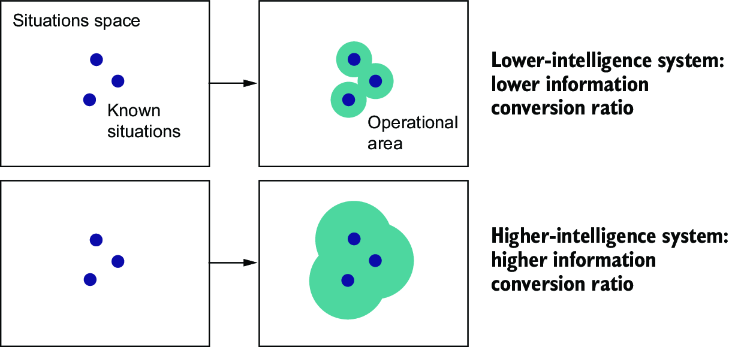
Compare local generalization with extreme generalization through the supplied figure. section 19.2.2

