An instruction is a directive in an LLM’s context that defines desired behavior, constraints, or task requirements. Instructions establish roles, safety boundaries, policies, and output expectations, framing how the model interprets subsequent context and responds to user requests. section 2.1
AI agents combine three complementary instruction mechanisms:
- System prompt: global guidance for the model’s role, goals, tone, rules, and response style, typically supplied before user input. section 1.5.1 section 2.1
- Agent skills: reusable packages of specialized procedures, checklists, examples, and resources that can be loaded when needed. section 1.5.1 section 2.1
- Instruction artifacts: agent-readable files containing durable project or environment guidance, such as conventions, commands, validation steps, and safety constraints. section 1.5.1 section 2.1
A context manager assembles these layers into the context window. It supplies global instructions and discovers local skills and artifacts. To conserve the token budget, it can initially load only skill frontmatter—the name and description—and load the full SKILL.md instructions when a task activates the skill. Project artifacts such as AGENTS.md or CLAUDE.md provide durable guidance alongside those instructions. section 2.1
Figure 2.1 Instruction material assembled into the AI agent’s context window. The context manager supplies global system instructions, compact skill frontmatter for discovery, loaded skill procedures upon task activation, and project instruction artifacts
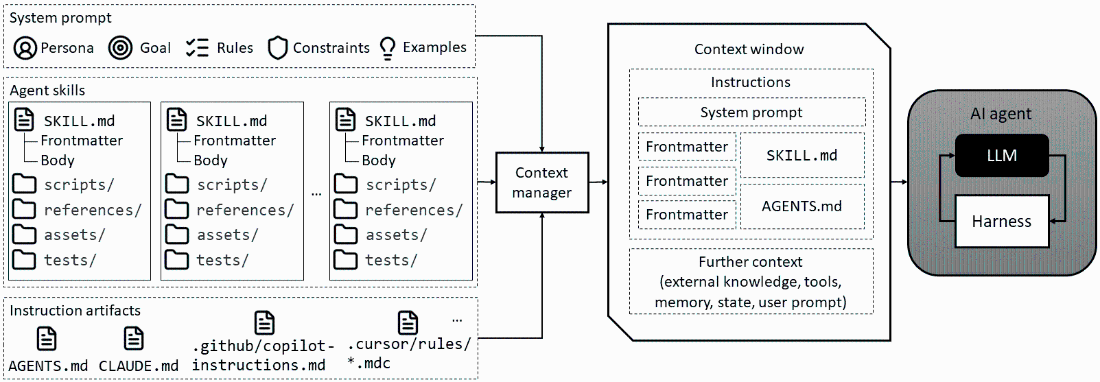
See how global instructions, skill metadata and procedures, and project artifacts enter the agent’s context window. section 2.1
Layering instructions for incident analysis
A system prompt can set the assistant’s professional tone and safety boundaries. An incident-analysis skill can then direct it to summarize the event, extract a timeline, identify the likely root cause, list mitigations, and report unresolved risks. An instruction artifact can add durable project-specific commands and validation requirements. section 1.5.1





