Instrument relevance is the instrumental-variable assumption that an instrument Z changes or predicts the treatment D. A useful instrument must do more than vary: its variation must move treatment decisions. In a causal diagram, relevance appears as an arrow Z → D. section 9.1.2
Figure 9.3 When we create this graph, we assume there are no other relationships between the variables. As we’ve discussed in previous chapters, the key assumptions in a DAG are about the arrows that are not shown rather than the ones that are.
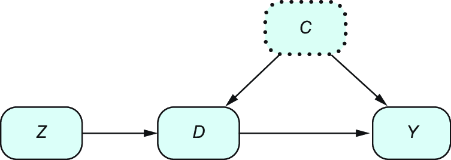
Use the DAG to check that relevance is represented by Z → D while keeping the instrument’s other required relationships explicit. section 9.1.2
Chatbot exposure and usage
Suppose Z indicates whether customers were exposed to a chatbot and D indicates whether they used it. If nobody exposed to the chatbot uses it, E[D|Z = 1] = 0, relevance fails. If some exposed customers use it, the difference E[D|Z = 1] − E[D|Z = 0] is positive and can support the IV estimate. However, a small difference creates a weak instrument: the IV formula divides by a value near zero, magnifying estimation errors and increasing variance. Simulations compare instrument effects of 0.3 and 0.1 to illustrate this instability. section 9.2.3 section 9.3.2
Relevance is necessary but not sufficient for a valid instrument. IV analysis also requires exogeneity and the exclusion restriction; relevance concerns only whether Z affects D. section 9.1.2 section 9.6
