A GenAI assistant can reproduce an article almost word for word even when the article was publicly available but never licensed for commercial redistribution. Intellectual property (IP) risk can enter through training data, fine-tuning data, or retrieval documents; it can also arise when users share protected information or the system produces protected material. section 6.6 section 6.6.1
Figure 6.12 IP risk lifecycle in GenAI deployments. Risk enters before ingestion through training data, fine-tuning datasets, and retrieval documents; propagates during use as memorized content and contractual terms shape what the model retains; and surfaces after release as verbatim reproduction, exfiltration, or model distillation. Arrows show how a licensing failure at ingestion can reappear as an output infringement claim months later.
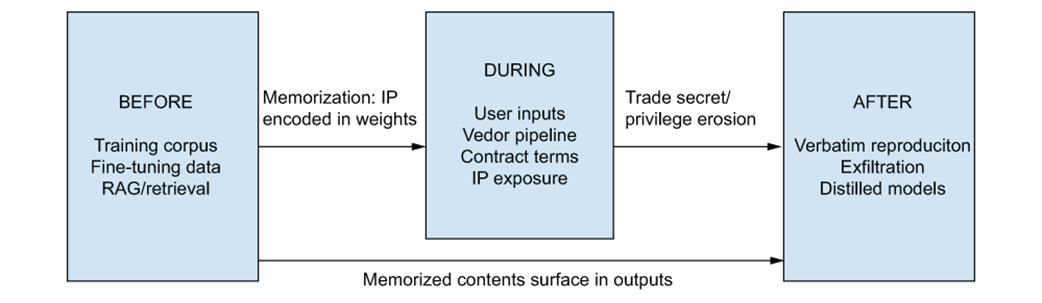
Trace how a licensing failure before ingestion can reappear as an output claim after release. section 6.6
Manage IP risk at three decision points:
- Before ingestion, establish provenance and rights for training and fine-tuning datasets and retrieval documents. Maintain a current data register recording each dataset’s source, acquired rights, and storage location. section 6.6.1
- During use, review provider terms and confidentiality obligations before sharing proprietary or legally sensitive information. Address ownership of fine-tuned weights and the consequences of exposing them in the vendor environment. section 6.6.2
- After release, check for reproduction of protected content and license obligations in outputs. A provider’s base-model protections may not cover copyrighted material supplied through retrieval or fine-tuning. section 6.6.3
Confidentiality affects more than commercial secrecy. Sharing legal communications with a provider whose terms permit collection or disclosure may jeopardize privilege. Disclosing a trade secret without enforceable confidentiality obligations can undermine its protection; disclosing an unfiled invention may also put patentability at risk. section 6.6.2
Licensing failure in an assistant
ClaimAssist reproduced automotive advice from unlicensed articles, prompting ElectraMotors to pull the model from production. Finding the corpus, rebuilding the dataset, and rerunning evaluations took weeks, with negotiations over past use still ahead. Separately, gaps in its vendor contract left ownership of fine-tuned weights unclear. section 6.6 section 6.6.2
Output risk also applies to code. A coding assistant can suggest a near-identical snippet from a copyleft-licensed project; shipping it in proprietary software may trigger license obligations. A fine-tuned model itself can also be a valuable asset if it contains an organization’s proprietary know-how. section 6.6.3 section 6.6.2





