Intent detection identifies what a user wants from a question, including the answer’s purpose and presentation format. In a knowledge-graph question-answering system, it runs first so the system can select an appropriate pipeline, imitate expert reasoning, and remain easy to inspect and debug. section 14.5
Implement intent detection as an evolving, staged classification pipeline:
- Define classes that match available system routes and outputs; revise, merge, or extend them as production needs change. section 14.5.1
- Classify broad question categories: data-related questions, system-related questions, and feedback or complaints. section 14.5.2 section 14.9
- Subdivide system-related questions into documentation-related requests and schema-related questions, routing each to the relevant source of answers. section 14.5.2
- For data questions, classify the desired visualization as graph, table, chart, or map. section 14.5.1 section 14.9
- Prompt the LLM with clear instructions, category definitions, examples, boundary cases, an expected output format, and a fallback category. section 14.5.1
- Pass the detected intent into query generation so graph and map requests return connected nodes and relationships, while table requests select and rename properties for columns. section 14.7.2
One question, different routes
A request about red Camaros spotted by cameras may require a graph showing vehicles, cameras, and their relationships, a table listing plates, locations, and capture times, or a map using camera locations. By contrast, “How do I export data to CSV?” is documentation-related, while “The system keeps freezing” is feedback or a complaint. section 14.5 section 14.5.2
Figure 14.6 Classification of system-related questions in the intent detection system, showing how requests are routed either to documentation (for system functionality and feature questions) or to the schema (for KG structure queries). The system also identifies feedback and issues as a separate category for user complaints or enhancement requests.
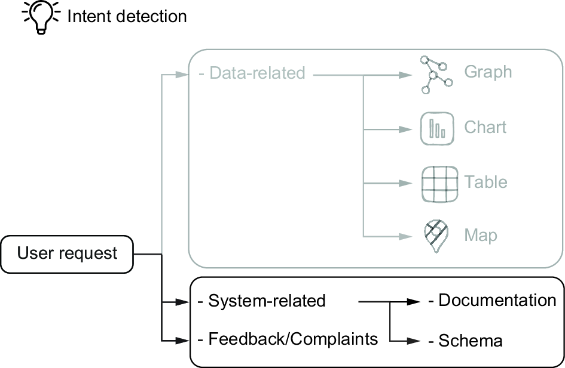
Use the classification diagram and prompt listing to trace how system-related questions divide into documentation, schema, and feedback routes. section 14.5.2
Figure 14.11 The complete flow of transforming a natural language question into a Cypher query, showing how three inputs are processed through structured prompt components. The process is organized into three stages (Input processing, Context building, and Final guidelines) that culminate in structured JSON output.
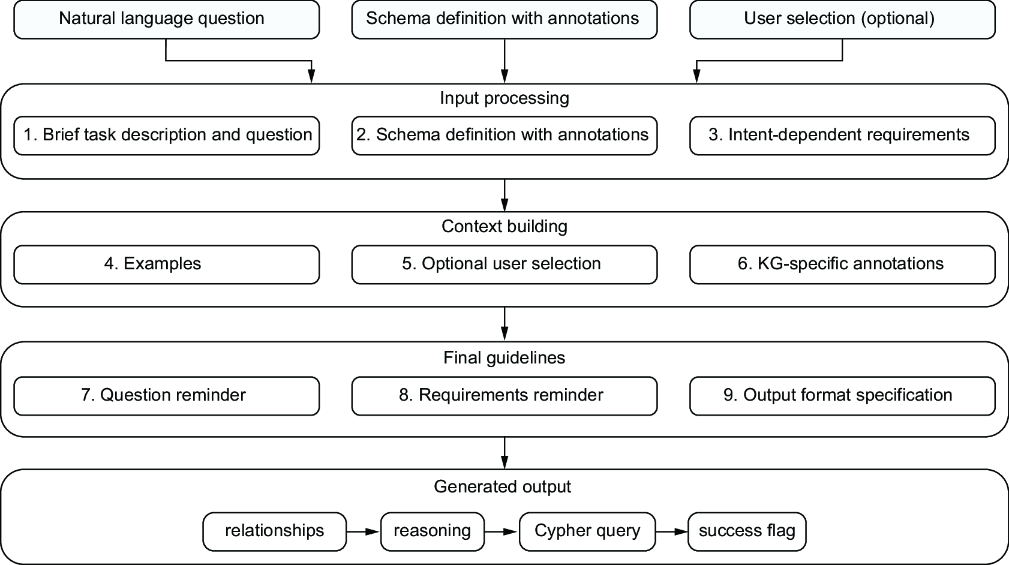
Use the flow diagram to connect detected intent with schema-aware Cypher generation and structured JSON output. section 14.7.2
