Latency measures elapsed time in a request or data flow. A synchronously coupled endpoint waits for each dependent service, so its response time accumulates their response times. section 4.4.1
Order creation
When the Order Service handles POST /orders, it waits for the Customer Service to validate the customer and reserve credit. The endpoint’s response time is the sum of both services’ response times. section 4.4.1
In CQRS, end-to-end latency is the time from a provider service committing a change until a view reflects it. This delay can leave a query returning stale data after an update. section 13.2.3
Figure 4.12 The Order Service cannot respond to the POST /orders request until the Customer Service has responded to the PUT /customers/{id} request. As a result, the availability of the POST /orders request is the product of the availability of the Order Service and the Customer Service
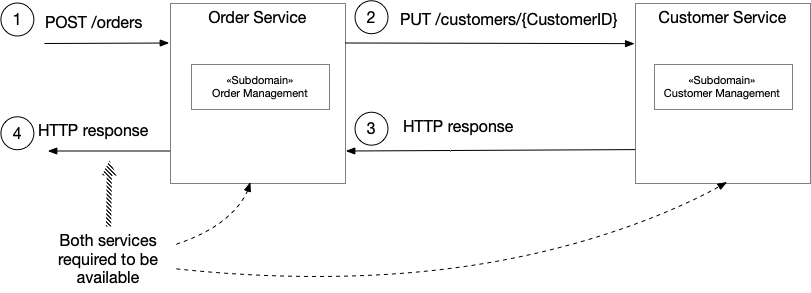
Shows the Order Service waiting for the Customer Service, illustrating how a synchronous dependency adds to endpoint response time. section 4.4.1