An internal representation is an information-bearing state that reflects aspects of the world or a task. In neural networks, successive stages of computation build representations of increasingly complex structure in data, combining many interacting signals into a response. section 3.0
A model’s parameters shape how inputs are transformed and which distinctions or similarities are preserved. Wider layers can represent more features at each step; deeper stacks can combine and transform them across stages. With limited capacity, subtly different linguistic situations may collapse into the same representation. More capacity allows finer distinctions, but does not guarantee that training will use it effectively. section 4.2.1
Converging representations
The Platonic Representation Hypothesis describes a reported tendency for larger, more capable models to organize information similarly, even when trained independently on different data types such as language and images. Some representations can be mapped onto one another through simple transformations. This alignment suggests shared statistical structure, but does not by itself establish a continuously maintained world model. section 5.4.5
Rich representations can support accurate prediction and fluent behavior without establishing human-like understanding. Human concepts connect perception, action, intention, and consequence; neural networks instead learn patterns from records of the world. Coherent output alone does not show that a system interprets those patterns through lived experience or agency. section 5.4.5
Figure 5.5 Human language refers to events and objects in the world through concepts grounded in perception, action, and consequence. Artificial neural networks instead learn patterns from indirect records of the world, such as text, images, or other data. As a result, models can generate coherent outputs by connecting representations within those records, without attaching them to a world they directly experience.
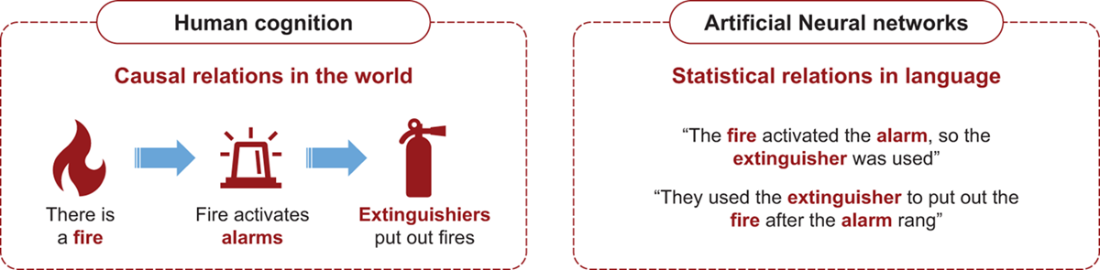
The figure contrasts human concepts grounded in experience with patterns learned from indirect records of the world. section 5.4.5

