An intervention deliberately changes a system to ask what would happen under a different treatment or setting. Unlike prediction, which describes likely outcomes from observed patterns, causal inference asks what can be changed and what effects would follow. section 1.2 section 2.2.4
For kidney-stone treatment, P(Treatment = A) describes patients who happened to receive A, whereas P|do(Treatment = A) describes a world in which everyone receives A. The latter supports comparing treatment effects. section 2.2.4
Formally, intervening on a node changes the data-generating process:
- Fix the treatment variable T to a chosen value, such as A. section 2.2.4
- Remove every arrow pointing into T, so prior causes no longer determine its value. section 2.2.4
- Use the resulting distribution to estimate what universal treatment or randomized assignment would produce. section 2.3
Kidney-stone treatment
Assigning treatment A to every simulated patient produces an approximately 83% recovery rate. Simulating an RCT, with treatment assigned randomly, produces similar estimates: about 83% for A and 75% for B. Randomization breaks the relationship between stone size and treatment, helping separate treatment effects from confounding. section 2.3 section 2.4.2
Figure 2.6 Data-generation process producing the intervened probability distribution P|do(T = A), which models what would happen if we gave treatment A to every patient
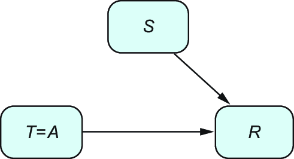
Use the intervened graph to compare the observed data-generating process with the scenario where treatment A is given to everyone. section 2.2.4

