An interventional quantity estimates a probability or distribution under a specified change, asking what would happen if an action were imposed rather than merely observed. section 4.0
Conditional probabilities forecast outcomes from historical assignments; interventional quantities address different scenarios, such as giving the same treatment to everyone. They are especially useful when future assignments may differ from the past. section 4.0
Discounts, loyalty, and purchases
Suppose loyalty affects both discount assignment and purchases. For a fixed loyalty level, the intervened and observed distributions coincide: P(Purchase | do(discount), loyalty) = P(Purchase | discount, loyalty). A predictive model therefore matches the interventional quantity only when it includes all possible confounders. section 4.1.4
Figure 4.2 Loyal customers receive discounts, which at the same time affect purchases.
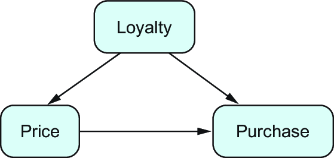
Use the causal diagram to trace how loyalty influences both discounts and purchases, creating the confounding that adjustment must address. section 4.1.4
Applying the adjustment formula

Use the adjustment-formula diagram to connect interventional quantities with conditional probabilities estimated by supervised learning. section 4.0
