The inverse quantum Fourier transform is the adjoint of the quantum Fourier transform. It converts information encoded in relative phases into amplitudes of computational-basis states. section 5.3.5 section 5.5
In quantum phase estimation, the inverse transform follows this workflow:
- Use controlled applications of U to encode an eigenphase across multiple control qubits as relative phases. section 5.3.5
- Recognize the resulting control-register state as the quantum Fourier transform of the phase bit string. section 5.3.5
- Apply inverse QFT to concentrate amplitude on basis states closest to the binary eigenphase representation. section 5.5
- Measure the control qubits to obtain phase bits, using big-endian notation when the first qubit stores the most significant bit. section 5.3.5
Two-bit phase estimation
Prepare two control qubits in |+⟩ states, apply one controlled U from the second qubit and two controlled U operations from the first, then apply inverse QFT and measure the two phase bits. section 5.3.5
Figure 5.8 In quantum phase estimation algorithm, we use multiple control qubits to encode the information about the eigenphase in phases of their states. Then, we use inverse quantum Fourier transform to convert that information from phase encoding to amplitude encoding, increasing the amplitude of the basis state that encodes the eigenphase compared to the amplitudes of other states. Finally, we measure the control qubits, reading out the bits of the phase as measurement results with high probability.
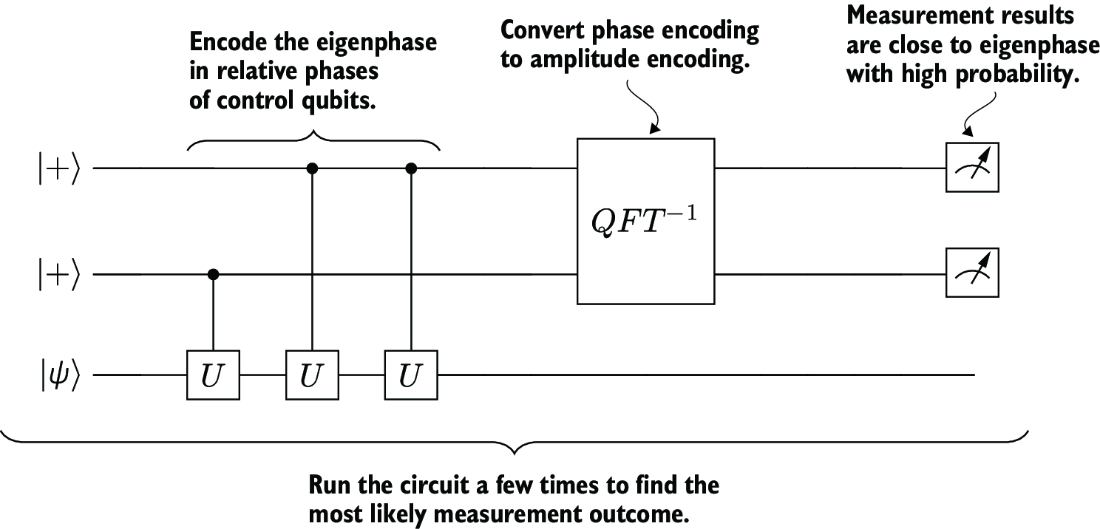
The diagram traces the information flow from phase encoding, through inverse QFT, to amplified computational-basis outcomes for measurement. section 5.3.5

