liveBook · Manning

IPv4

As explained in Fundamentals of Cybersecurity

IPv4 is the fourth version of the Internet Protocol that uses 32-bit network addresses.

IPv4 (Internet Protocol version 4) is an older form of IP addressing. An IPv4 address has 32 bits, arranged in four groups of eight. Dotted-decimal notation makes those groups easier to read. section 11.5.2

Reading the groups

The eight-bit group 11000000 appears as 192 in decimal; 10101000 appears as 168. An IPv4 address displays four such decimal groups separated by dots. section 11.5.2

A DHCP server can assign an IP address when a device joins a network. IPv4 has about 4.29 billion possible addresses, which is not enough for today’s many connected devices. Network Address Translation (NAT) lets many devices share one public IP address; IPv6 offers a much larger address space. section 11.5.2

Figure 11.6 Illustration IPv4 address as 32 bits grouped as four bytes in dotted decimal notation
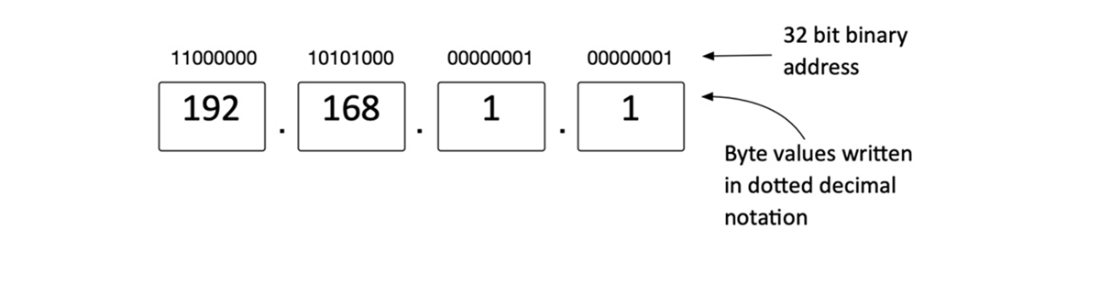
Shows how an IPv4 address’s 32 bits become four dotted-decimal groups. section 11.5.2


How Fundamentals of Cybersecurity covers it

How deep it goes
Explains 32-bit grouping and dotted-decimal notation with a conversion example, without detailing address configuration.
Examples
Shows eight-bit binary groups becoming decimal numbers and illustrates the full address layout in a diagram.
What it assumes
Introduces bit grouping and binary-to-decimal conversion through an example.
What you can do after
Evaluate/understand an IPv4 address’s format and the reason NAT and IPv6 are discussed alongside it.
How it connects
Connects IPv4 to DHCP, Network Address Translation, IPv6, and address exhaustion.

Also explained in

Compare how 3 books explain IPv4 →

Related concepts

This explainer was generated by Manning's knowledge graph from the text of Fundamentals of Cybersecurity. The section links point to the parts of the book it draws on.