Private IPv4 addresses support internal networks without requiring globally unique addresses. They conserve IPv4 space, but packets using them cannot travel directly over the public internet. section 9.0 section 9.1
RFC 1918 defines three private IPv4 ranges:
- 10.0.0.0/8 — 10.0.0.0 through 10.255.255.255 section 9.1
- 172.16.0.0/12 — 172.16.0.0 through 172.31.255.255 section 9.1
- 192.168.0.0/16 — 192.168.0.0 through 192.168.255.255 section 9.1
Organizations can reuse these ranges because separate networks do not need unique addresses when they are not directly connected. NAT translates private addresses to public addresses so internal hosts can communicate over the internet. section 9.1 section 9.2
Private host using NAT
PC1 sends a packet sourced from its private address. R1 translates that source address to a public address before forwarding it, then translates the reply back to PC1’s private address. section 9.2.1
Figure 9.1 Public and private IPv4 addresses. Private IPv4 addresses can be freely used for internal networks and do not have to be globally unique. Public IPv4 addresses, used for communication over the internet, must be globally unique.
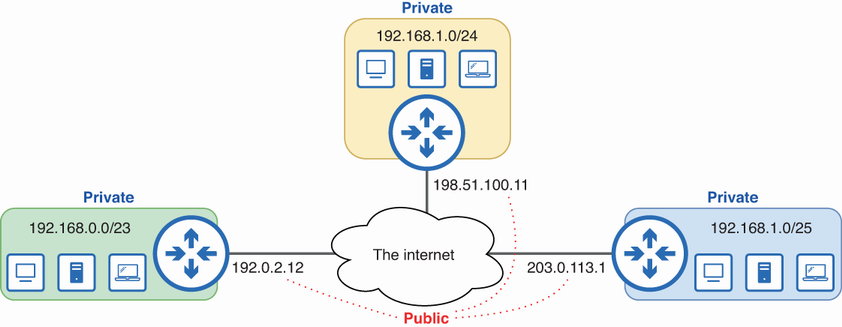
Compare reusable private LAN ranges with globally unique public IPv4 addresses and observe why overlapping internal subnets can coexist. section 9.1
