An IPv6 header is a fixed 40-byte network-layer header carrying packet control and addressing information. Its fixed size simplifies length handling compared with IPv4 and provides context for understanding IPv6 packets. section 20.3.1
The header contains eight fields:
- Version: 4 bits, always 0b0110 (decimal 6), identifying IPv6. section 20.3.1
- Traffic Class: 8 bits for QoS, divided into DSCP and ECN. section 20.3.1
- Flow Label: 20 bits for labeling packet flows between a source and destination. section 20.3.1
- Payload Length: 16 bits indicating the encapsulated payload size. section 20.3.1
- Next Header: identifies the encapsulated message, such as TCP, UDP, ICMP, or ICMPv6. section 20.3.1
- Hop Limit, Source Address, and Destination Address complete the header. section 20.3.1 section 20.6
Reading Next Header
A Next Header value of 6 indicates that a TCP segment is encapsulated inside the IPv6 packet. Unlike IPv4, IPv6 needs only Payload Length because its header size is always 40 bytes. Exam questions focus on this basic structure rather than field-specific details. section 20.3.1
Figure 20.2 The format of the IPv6 header. The fields are Version, Traffic Class, Flow Label, Payload Length, Next Header, Hop Limit, Source Address, and Destination Address. The header is 40 bytes in size.
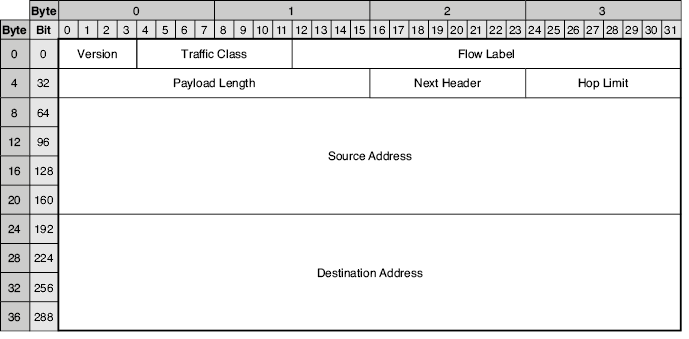
Use the header-format figure to relate the eight fields to the fixed 40-byte layout. section 20.3.1
