Isolation Forest detects outliers by asking how quickly a record can be separated from other records. Rather than model normal behavior and measure departures from it, it repeatedly partitions the feature space at random. Records isolated after fewer splits are more likely to be outliers. It is a broadly useful starting point for numeric tabular data, but no single detector finds every kind of outlier. section 5.2 section 5.0
Training builds multiple isolation trees, each from a different small random sample of records. At each node, a tree chooses a feature and a split point within that feature’s range, then subdivides the records. Unlike a supervised decision tree, the split is not chosen to improve a prediction. When a leaf holds duplicate training values, the tree estimates the additional depth needed to isolate a record there; common duplicates therefore need more estimated steps than rare ones. section 5.2 section 9.4.2
Figure 5.1 The training data for an Isolation Forest is divided randomly in each Isolation Tree. This shows the first three steps, resulting in eight nodes, each covering some subregion of the full dataspace. At this point (in the bottom right pane), one point (in the top right region) has already been isolated.
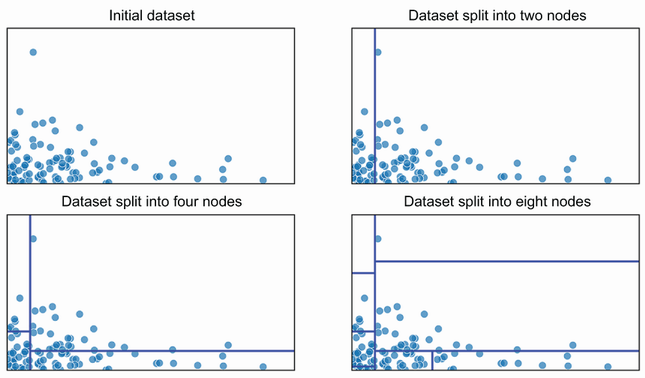
The successive partitions show how a point can be isolated within the first few levels of one tree. section 5.2
A practical scikit-learn workflow is:
- Encode categorical columns before fitting. Scaling is not required for Isolation Forest, unlike the distance-based scikit-learn detectors discussed alongside it. section 5.1
- Fit `IsolationForest`, then use `predict()` for labels (`-1` for outliers, `1` for inliers) or `score_samples()` for record-level scores. An explicitly set `contamination` specifies the fraction flagged; the default instead uses a formula. section 5.1 section 5.2.2
- Inspect flagged records and compare detectors where possible. A flag identifies a candidate for investigation, not proof that the record is a meaningful anomaly. section 5.0 section 5.2.2
Network-event detection
On the KDD Cup SA subset, three categorical columns are ordinal-encoded before fitting `IsolationForest`. The resulting scores achieve an AUROC of about 0.95 against available attack labels, though runs without a fixed seed vary because the algorithm is stochastic. The predictions also include 8,155 non-attack records flagged as outliers and 29 attacks not flagged: good ranking does not make every binary decision correct. Training on clean records, when available, raises the reported AUROC to about 0.98 in this example. section 5.2.2
Ordinal encoding can be useful here because it avoids the extra columns created by one-hot encoding. For example, if one encoded department value occurs far less often than another, duplicate-leaf depth estimates can help distinguish their frequencies. This does not make arbitrary ordinal values suitable for distance-based detectors. Compare Isolation Forest with alternatives such as Local Outlier Factor, and measure fit and prediction time when deployment speed matters. section 9.4.2 section 8.7
