An information technology (IT) system supports business processes rather than primarily monitoring or controlling physical processes. In a digital twin, IT systems supply the business context needed to interpret operational technology (OT) measurements. IoT devices can blur the boundary; their primary role—business support or physical monitoring and control—is the useful distinction. section 4.2 section 4.2.2
An enterprise resource planning (ERP) system can provide asset records, maintenance schedules, procurement records, and organizational hierarchies. If a pump’s vibration differs from its historical baseline, its recent installation may help explain the change. ERP data typically changes slowly, so a digital twin can often access it in place through an API or database connection rather than importing it. Financial and procurement data can also bring cost into operational decisions; existing business intelligence tools may already hold useful metrics and rules. section 4.2.2
Listing 4.2 Accessing data from a public SAP sandbox, a common ERP system
import requests

url = "https://sandbox.api.sap.com/s4hanacloud/sap/opu/
odata/sap/API_SALES_ORDER_SRV/A_SalesOrder"  #1
headers = {
  "APIKey": "your_api_key_here",  #2
  "Accept": "application/json"
}

params = {
  "$top": "5",
  "$select": "SalesOrder,SoldToParty,SalesOrderDate,TotalNetAmount",
}

response = requests.get(url, headers=headers, params=params)

if response.status_code == 200:
  orders = response.json()["d"]["results"]
  print(f"{len(orders)} Sales Orders from SAP:")

  for order in orders:
    so_id = order.get("SalesOrder", "N/A")
    customer = order.get("SoldToParty", "N/A")
    amount = order.get("TotalNetAmount", "N/A")
    print(f"  {so_id}: Customer {customer} - ${amount}")
else:
  print(f"Error: {response.status_code}")
The Python listing queries a public SAP sandbox through an OData API. It sends an API key, selects sales-order fields, limits the response to five orders, and checks the HTTP status before reading the results. Linking order data with sensor data can help answer questions about delivered-goods quality. section 4.2.2
Digital twin applications typically run in IT environments but depend on OT data. Directly connecting the networks creates a security risk: a compromised IT device must not be allowed to affect physical infrastructure. Mirroring OT data into a separate analytical environment protects operational systems, at the cost of latency and storage. An industrial demilitarized zone (DMZ) provides a buffer between the networks. section 4.2.3
Figure 4.4 The Purdue model of IT/OT convergence segments the network into layers, with a DMZ acting as a buffer zone between the OT and IT networks.
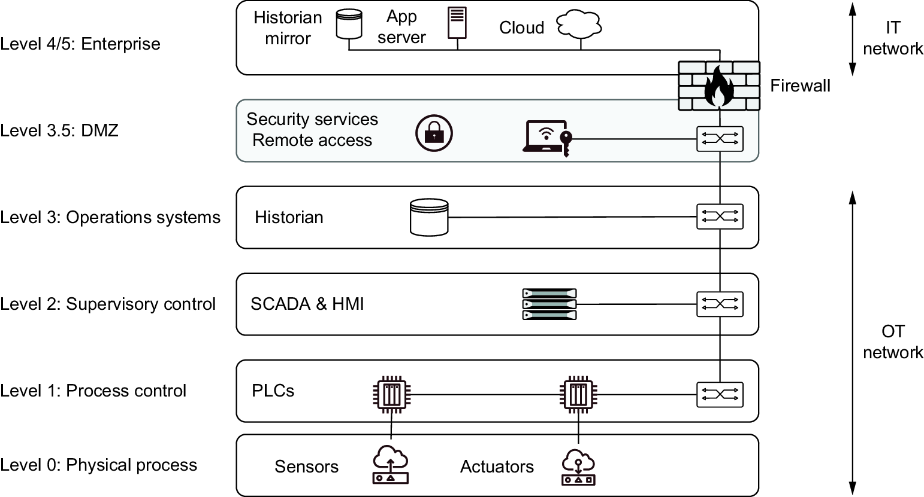
The Purdue model figure locates the DMZ between segmented OT and IT networks, making the separation visible when planning digital twin data flows. section 4.2.3

