Italics use slanted letterforms to emphasize words or give text a different voice. True italics often add script-like design details, while oblique styles mainly slant the regular characters. section 8.1.3
Choose the markup according to what the styling communicates:
- Use <em> when italics add emphasis. section 8.1.3
- Use <i> when italics mark an alternate mood or voice, or distinguish idiomatic, technical, or taxonomical text. section 8.1.3
- Use a generic HTML element with a CSS class and font-style: italic when the treatment is purely decorative. section 8.1.3
A practical choice
In “Read the instructions carefully,” use <em> for the emphasized word. In a technical term or an expression written in another voice, use <i>. For a visual accent with no semantic meaning, apply a CSS class instead. section 8.1.3
Figure 8.10 Italics aren’t just slanted; they have design elements added that make the slant feel more cursive and natural.
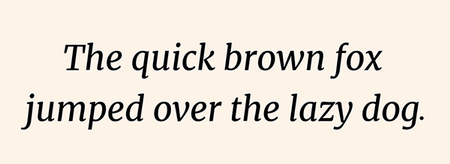
Compare true italics with ordinary slanting: italic letterforms introduce design changes that make the text feel more cursive and natural. section 8.1.3
