An iteration schedule chooses how many Grover-operator applications to try on each adaptive-search attempt. It replaces an ideal fixed count when the number of good outcomes is unknown, letting the search test different amplification depths before measuring. section 11.1
A schedule may randomly select counts from an exponentially growing range or follow a fixed pattern. Zero is a valid count: the state is measured without applying the Grover operator. A stopping condition is needed to end unsuccessful searches. section 11.1
An adaptive-search attempt follows this control loop:
- Choose a nonnegative iteration count from the schedule. section 11.1
- Prepare the search state, apply the selected number of Grover iterations, and measure. section 11.1
- Finish on a good outcome; otherwise continue unless the stopping condition is met. section 11.1
Fixed counts in a Grover optimizer
A knapsack optimization run first measures with zero iterations, then tries one iteration. After finding a feasible value of 3, it raises the minimum target to 4 and repeats the schedule against the updated search state. A longer fixed pattern can be supplied to the optimizer as an alternative schedule. section 11.3.3 section 11.4
In optimization, successful measurements tighten the encoded threshold so later attempts seek better solutions. The schedule and threshold updates therefore work together in a hybrid Grover optimizer; an efficient oracle remains central to efficiency. section 11.4
Figure 11.2 A flow diagram of Grover adaptive search
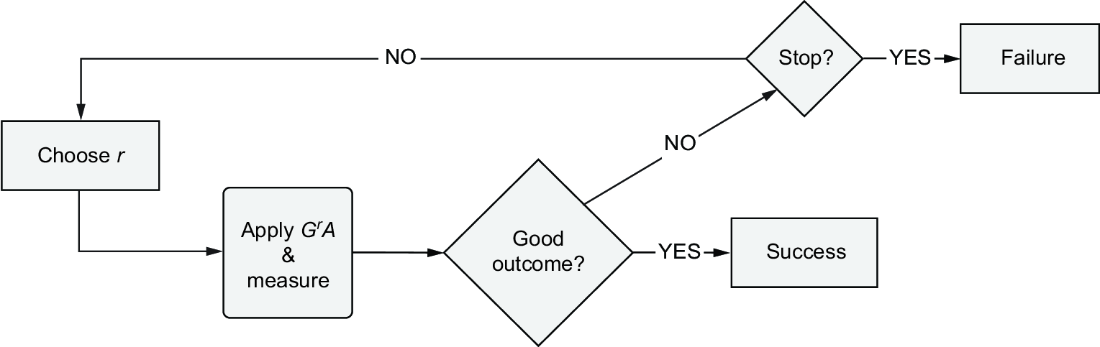
Follow the adaptive-search flow from schedule choice through measurement, success, failure, and stopping. section 11.1
