Jitter is randomized variation added to an agent’s sleep interval before repeated communication. In command-and-control beaconing, it turns a fixed callback cadence into an inconsistent one, helping activity blend in and making simple periodicity checks less reliable. section 7.1 section 7.1.5
A jittered beacon
An agent sleeping for 60 seconds with 20% jitter can select a uniformly random interval from 48 to 72 seconds before each HTTP call home. The resulting connection gaps no longer have the very low standard deviation expected from a fixed 60-second beacon. section 7.1
This variation can create a false negative when detection logic searches only for highly consistent network flows. Raising a standard-deviation threshold alone may still fail to identify the unknown activity, so timing analysis must account for noise, skew, and nonnormal distributions. section 7.1.1 section 7.1.2
Investigate suspected jittered beaconing with a timing-focused workflow:
- Group TCP and UDP events by source IP, destination IP, and destination port, then calculate the time difference between successive connections. section 7.1
- Calculate lower and upper quartiles for the connection intervals and use the interquartile range (IQR) to remove intervals outside those bounds. section 7.1.2
- Recalculate variance, standard deviation, and connection count on the retained intervals; then filter known benign destinations before prioritizing candidates. section 7.1.2
- Plot intervals over time and as histograms. A line chart may not reveal a clear pattern, while a right-skewed histogram can still show that many intervals retain some consistency. section 7.1.5
Figure 7.11 Distribution of time_diff_sec between 10.0.0.4 and 162.125.2.14 over port 443
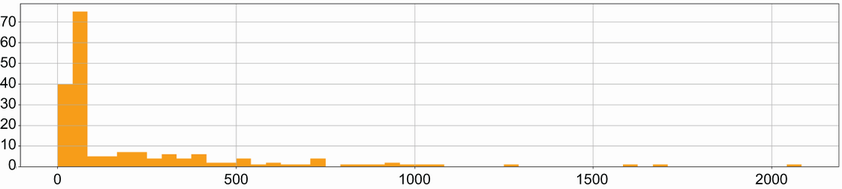
Use the histogram to inspect the distribution of connection gaps after a time-series view fails to show an obvious recurring pattern. section 7.1.5
IQR does not prove that a flow is malicious. It narrows attention by reducing the effect of distant values before measuring remaining timing behavior, which is useful when an adversary’s jitter changes the apparent distribution of callback intervals. section 7.1.2 section 7.1.5
