A journal is an append-only store of events. It preserves an actor’s history in write order and returns that history in the same order. Rather than replacing a single stored state value, a persistent actor records accepted changes as ledger entries. section 1.5.1 section 9.2
A command first expresses an intended change. The actor validates it; if accepted, it produces an event and stores it in the journal. The event history is therefore the durable record used to reconstruct state, while normal application logic can remain message-oriented instead of database-operation-oriented. section 1.5.1 section 9.2
A journal supports two central operations:
- Append each accepted event, retaining the complete history of a persistent actor. section 9.2
- Replay events in stored order after restart to return an actor to its last known state. section 1.5.1 section 9.2
- Expose events for independent readers that build tables, topics, external-service calls, or other views. section 10.0 section 10.2.1
Recovering a conversation
A Conversation actor keeps MessageAdded events for messages added in memory. On a web-server restart, it reads those events back and replays them to rebuild the conversation, then continues processing new messages. The database is used for recovery rather than as the vocabulary of the application’s code. section 1.5.1
Journal data can also serve requirements that were not anticipated when an actor was designed. A stream of AddCargo events can be aggregated by container to maintain total weight in another store. Separating this read-side aggregation from event writing decouples readers from writers and allows the derived data to scale independently. section 10.0 section 10.2.1
Projection-driven settlement
A projection can read Market.Closed events from a market journal. A listener can then find bets for that market and send each bet a Settle message; another projection can store bet and market identifiers for that lookup. The same event history thus supports operational workflows beyond actor recovery. section 12.1.3
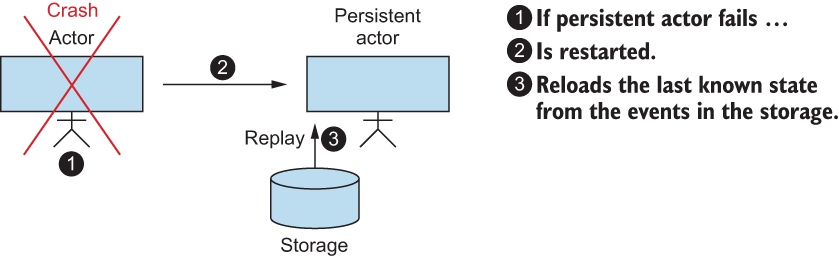
The recovery flow visualizes the journal as the durable event history replayed to restore a persistent actor’s state after restart. section 9.2
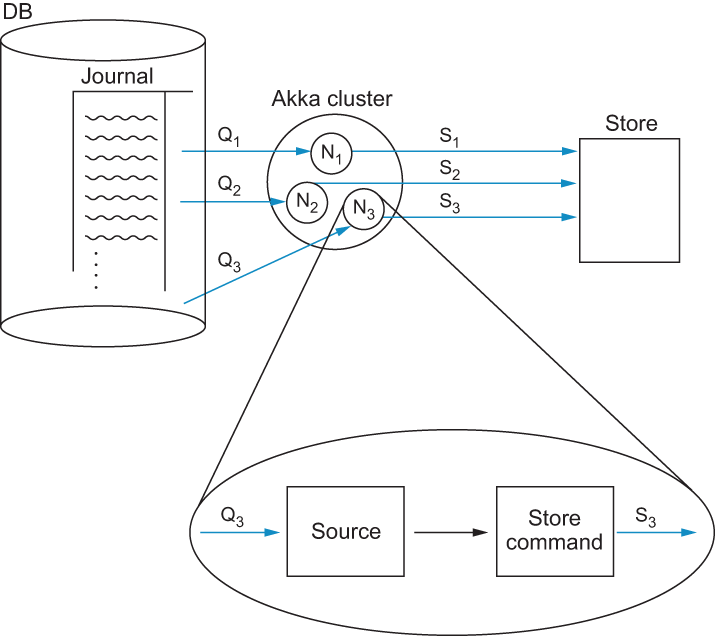
The read-side architecture shows journal events flowing through aggregation and storage into a separate database or topic. section 10.2.1
