liveBook · Manning

Cap

As explained in Geometry for Programmers

A cap is a degenerate triangle whose three distinct vertices lie on the same line.

A cap is a degenerate triangle with three distinct, collinear vertices. It has zero area and differs from a needle, whose two vertices coincide. Although it still looks like a triangle in data, geometrically it has collapsed into a segment. section 2.2.2

Caps create practical problems in triangle-based models:

  • They disrupt topology—the question of which elements touch which. section 2.2.2
  • They can violate the expected neighbor and edge relationships of a manifold triangle mesh. section 2.2.2
  • They matter in models used by games and 3D-printing software, where manifold surfaces are common. section 2.2.2

Spot the cap

Given three different vertices A, B, and C placed along one straight line, classify ABC as a cap. If two vertices instead occupy the same position, classify it as a needle. section 2.2.2
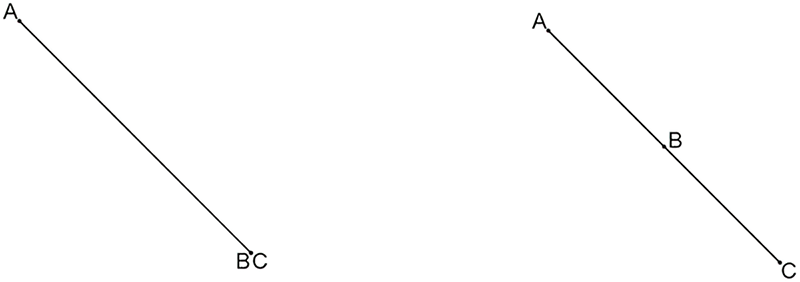
Figure 2.10 Not all degenerate triangles are the same. Some are needles, and others are caps.
02-10

Compare the two kinds of degenerate triangles: caps and needles. section 2.2.2

How Geometry for Programmers covers it

How deep it goes
Defines collinearity and zero area, distinguishes needles, and connects caps to mesh failures while deferring full manifold theory.
Examples
Uses figures comparing ordinary triangles, caps, needles, and a degenerate triangle inside a manifold mesh.
What you can do after
Diagnose/debug with it by recognizing collinear vertices that create degenerate triangles and threaten mesh topology.
How it connects
Connects degenerate triangles with needles, topology, triangle meshes, edges, neighbors, and manifold meshes.

Related concepts

This explainer was generated by Manning's knowledge graph from the text of Geometry for Programmers. The section links point to the parts of the book it draws on.