liveBook · Manning

Needle

As explained in Geometry for Programmers

A needle is a degenerate triangle in which two vertices coincide, producing a sharp endpoint and a coincident pair of vertices.

A needle is a degenerate triangle: two vertices coincide, so the triangle has zero area and becomes a segment with a sharp endpoint and a coincident “eye.” section 2.2.2

Needles are one of two degenerate-triangle types, alongside caps. In a triangle mesh, they can disrupt topology—the question of which vertices, edges, and triangles touch—which can invalidate expected neighborhood relationships. section 2.2.2
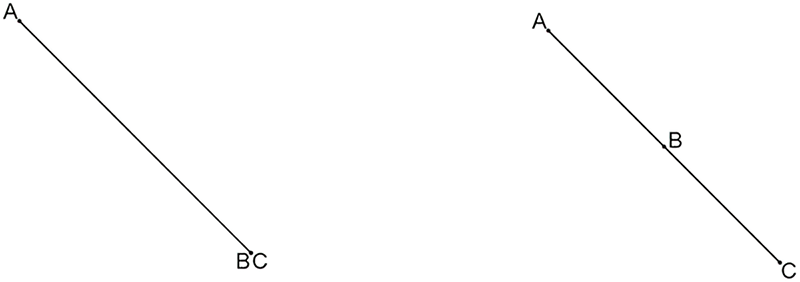
Figure 2.10 Not all degenerate triangles are the same. Some are needles, and others are caps.
02-10

Compare needles with caps by inspecting the figure’s degenerate triangle shapes. section 2.2.2

How Geometry for Programmers covers it

How deep it goes
Defines coincident vertices and explains topology problems, but stops short of detailed manifold-handling algorithms.
Examples
Uses geometric figures contrasting needles and caps and illustrating a degenerate triangle within a mesh.
What it assumes
Builds the needle distinction from basic triangle, vertex, edge, and neighbor terminology.
What you can do after
Evaluate whether a triangle is degenerate and recognize why it may disrupt mesh topology.
How it connects
Connects needles to degenerate triangles, caps, triangle meshes, topology, and manifold meshes.

Related concepts

This explainer was generated by Manning's knowledge graph from the text of Geometry for Programmers. The section links point to the parts of the book it draws on.