A kernel function measures similarity between inputs and represents their inner product in a transformed feature space. This lets a model find nonlinear decision boundaries by separating points in a richer space. section 11.3
For an SVM, the kernel method adds features so data that cannot be separated by a line may become separable by a plane. Projecting that boundary back to the original space can produce a curve. A radial basis function (RBF) kernel gives higher similarity to nearby points and lower similarity to distant ones; polynomial kernels offer another option. section 11.3
Similarity with an RBF kernel
For two points at distance √2, the example similarity is e⁻², or about 0.135. Adding similarity features for the data points can make a one-dimensional dataset with a middle point of one class and two outer points of another linearly separable. section 11.3
Figure 11.17 The kernel method. Step 1: We start with a dataset that is not linearly separable. Step 2: Then we raise each point by a distance that is the square of its distance to the origin. This creates a paraboloid. Step 3: Now the triangles are high, whereas the squares are low. We proceed to separate them with a plane at height 1. Step 4. We project everything down. The intersection between the paraboloid and the plane creates a circle. The projection of this circle gives us the circular boundary of our classifier. (Source: Image created with the assistance of Grapher™ from Golden Software, LLC; https://www.goldensoftware.com/products/grapher).
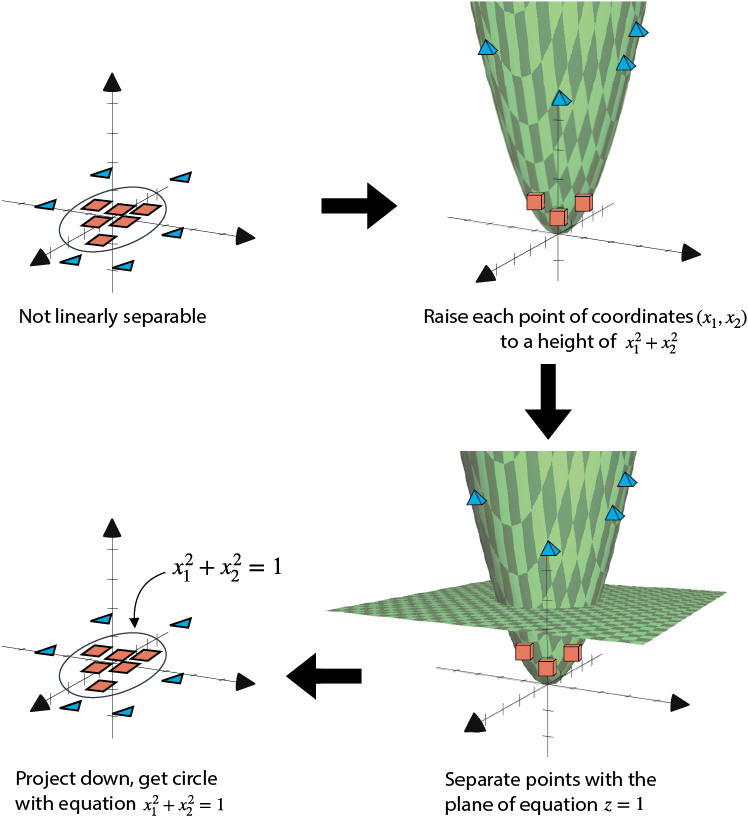
See how raising points by their squared distance makes a dataset separable by a plane, whose projection becomes a circular boundary. section 11.3
Try the XOR dataset: choose a kernel that makes it linearly separable, then sketch the resulting SVM boundary. section 11.5



