A qualitative engine turns financial news into structured, probabilistic signals about market narratives. It complements price-based analysis; it does not act as an oracle or automated trader. Its role is first-pass analysis, with a human analyst retaining final judgment. section 11.0 section 11.1.2
A retrieval-augmented workflow converts news into machine-readable signals:
- Collect recent news from public APIs and RSS feeds; preprocess the text and optionally split it into chunks. section 11.1.4
- Create embeddings, enrich documents with metadata such as date, source, and topic, and store them in a vector database. section 11.1.4
- Embed an analysis query, retrieve relevant documents, and combine their context with a structured prompt for the LLM. section 11.1.4
- Return signals in JSON for downstream use, including sentiment, supply risk, or policy tone. section 11.1.4
Figure 11.1 The qualitative engine architecture: end-to-end pipeline from raw news to structured signals. Raw text from APIs and RSS feeds enters the RAG feature engineering pipeline (data cleaning, embedding, vector database storage). When a user query arrives, the system retrieves relevant documents and constructs a structured prompt for the LLM, which outputs quantifiable signals (sentiment, supply risk, policy tone) in JSON format.
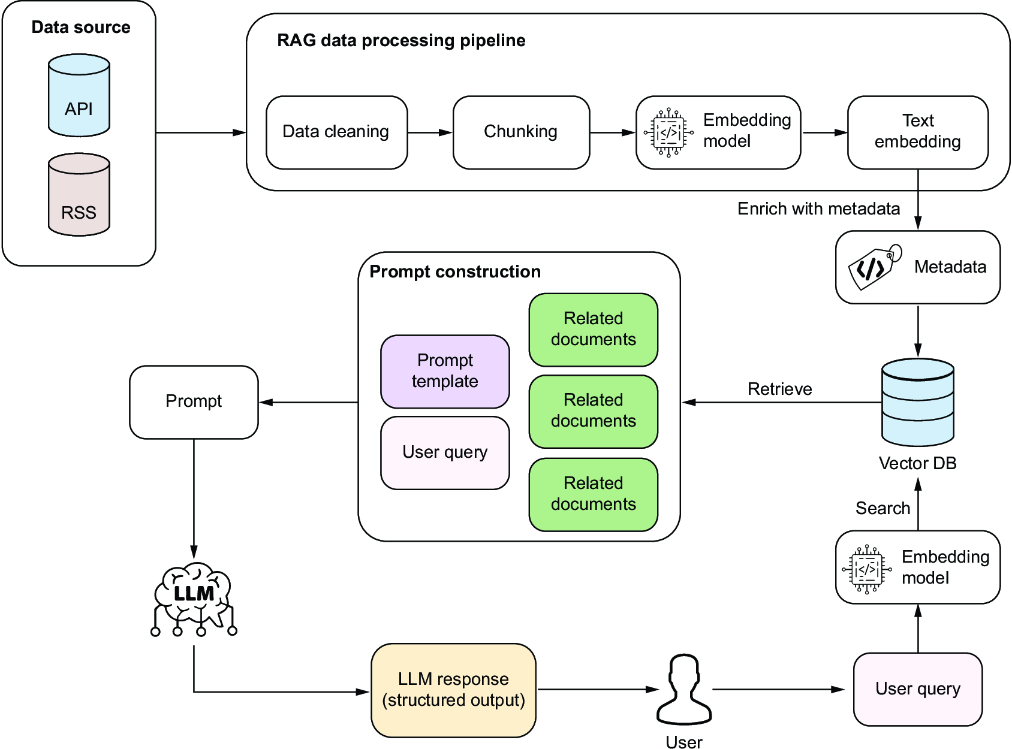
Use the architecture diagram to follow news from collection through retrieval and LLM analysis to structured signals. section 11.1.4
Grounding analysis in fresh, verifiable sources supports consistent, auditable interpretation. The resulting signals can be combined with quantitative signals, while human analysts focus on judgment and decisions. section 11.0 section 11.1.2
