Knowledge graph construction creates a unified, grounded representation from heterogeneous information. It begins with a problem definition and domain understanding, then scouts, explores, and integrates data into reusable concepts and relationships. section 3.6 section 5.0
A practical construction pipeline includes:
- Define the problem and reference domain before selecting data or technologies. section 3.6
- Ingest and process structured or unstructured sources using NLP, data enrichment, machine learning, and data modeling. section 5.0
- Choose RDF for knowledge representation and ontology construction, or LPG for efficient query-based traversal and path analysis. section 3.6
- Extract entities and relationships with prompts, then fine-tune a model when prompt-only output is insufficient; iterate with additional training data. section 5.3.1
Extracting knowledge from archives
Emails, chats, laws, research papers, news, and social media can be transformed into connected knowledge. An archive project illustrates the need to resolve varying references to the same person before generating the graph. section 5.0 section 5.3.1
Figure 5.4 The two roles of LLMs in KG generation from textual data: the prompt-based approach (upper branch) and the fine-tuning approach (lower branch)
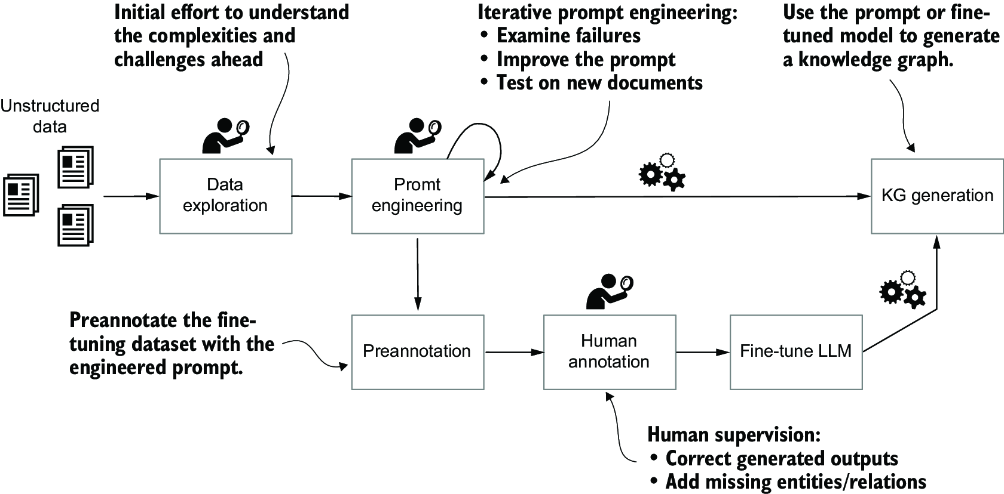
Compare prompt-based extraction with the fine-tuning path for generating a knowledge graph from textual data. section 5.3.1
