Knowledge representation is the language an intelligent system uses to structure, encode, store, and communicate domain information. It supports reasoning and prediction, helps people interpret outputs, and influences system capabilities, limitations, and processing efficiency. section 2.1
A practical knowledge-representation pipeline includes:
- Acquire examples, evidence, rules, feedback, and environmental data. section 2.1 section 2.3
- Convert raw, structured, or semistructured data into representations tailored to reasoning requirements. section 2.3
- Store the resulting knowledge in one or more knowledge bases and pass it among reasoning engines. section 2.1 section 2.3
- Refine knowledge through sequential or parallel processes while balancing expressiveness against processing efficiency. section 2.1
Explicit and implicit representations
A knowledge graph converts heterogeneous data into entities, relationships, and properties guided by an ontology or schema. A large language model instead encodes unstructured text as statistical patterns in dense vector spaces. Graph representations are inspectable and modifiable but require careful preparation; implicit representations capture contextual meaning with less preparation but are opaque. section 2.3
Figure 2.1 A high-level schema of an intelligent system. It is made of two component types: knowledge bases and reasoning engines. Each type can have multiple instances based on the system’s tasks.
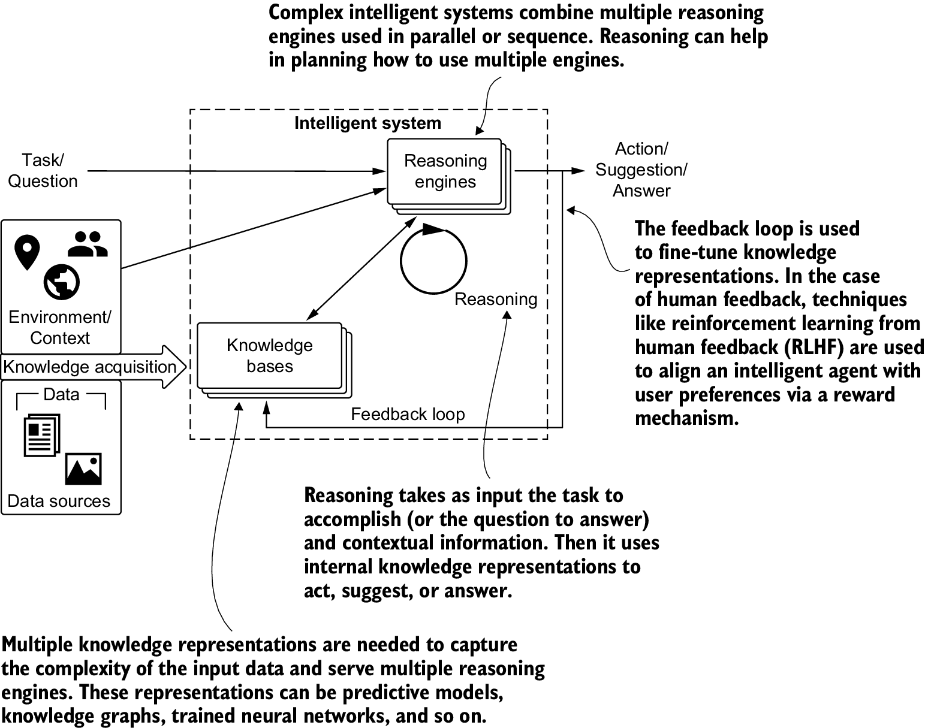
Use the architecture to trace how multiple knowledge bases and reasoning engines interact, including sequential, parallel, and knowledge-refinement flows. section 2.1
