liveBook · Manning

Kube-proxy

As explained in Kubernetes in Action, Second Edition

kube-proxy is a Kubernetes node component that implements network connectivity and load balancing for services and their application endpoints.

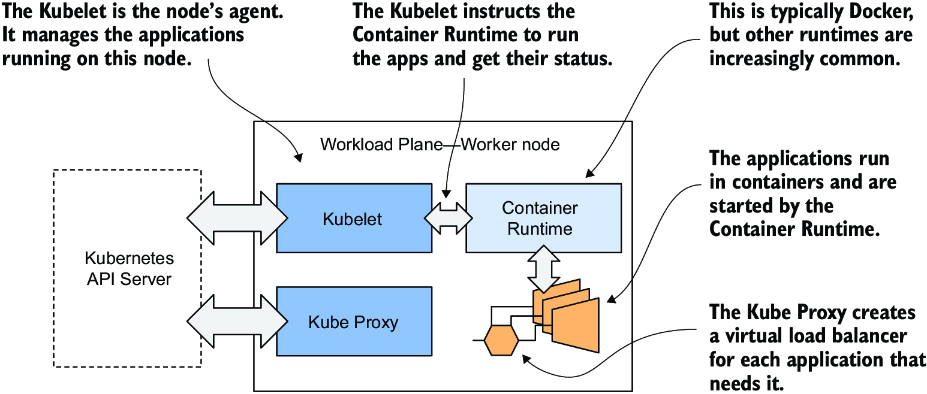
kube-proxy is a Kubernetes component that runs on each worker node. It provides connectivity to applications by load-balancing network traffic between application instances. section 1.2.3

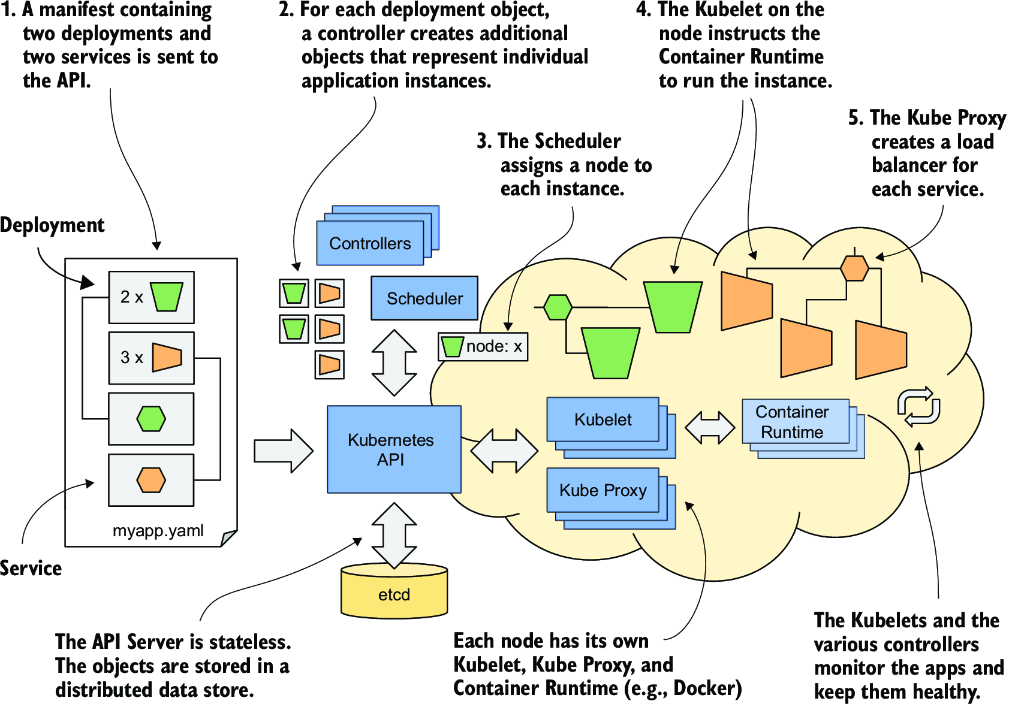
When an application is deployed, controllers create its instances, the scheduler assigns them to nodes, and Kubelets start them through the container runtime. After the instances become ready, kube-proxy notices them and configures a load balancer so clients can connect. section 1.2.4

Connecting clients to application instances

A manifest defines applications exposed through services. After the manifest reaches the Kubernetes API and the application instances are running, kube-proxy configures traffic distribution across those instances, rather than requiring clients to address each instance separately. section 1.2.4

Figure 1.13 The Kubernetes components that run on each node
figure

Use the node-components diagram to locate kube-proxy alongside the Kubelet and container runtime on a worker node. section 1.2.3

Figure 1.14 Deploying an application to Kubernetes
figure

Use the deployment-flow diagram to follow how submitted application objects become running instances and receive load-balanced connectivity. section 1.2.4


How Kubernetes in Action, Second Edition covers it

How deep it goes
Explains kube-proxy’s role and deployment-lifecycle position, but stops short of implementation mechanics or configuration details.
Examples
Uses a manifest defining applications and Services, then follows ready instances receiving load-balanced client traffic.
What it assumes
Starts with basic Kubernetes component names and assumes no prior implementation knowledge of kube-proxy.
What you can do after
Evaluate/understand how Kubernetes turns ready application instances into load-balanced network endpoints.
How it connects
Connects kube-proxy with worker nodes, Services, application instances, Kubelets, controllers, the scheduler, and the container runtime.

Also explained in

Compare how 2 books explain kube-proxy →

Related concepts

This explainer was generated by Manning's knowledge graph from the text of Kubernetes in Action, Second Edition. The section links point to the parts of the book it draws on.