A labeling guideline tells annotators how to label data. Clear definitions and current examples help people apply labels consistently, but instructions must evolve when annotators encounter cases they do not cover. section 7.2.4 section 7.6.2
Guidelines are part of the annotation process, not a substitute for it. Before scaling up, labeling leaders should iterate on instructions, investigate systematic errors, and refine the task. A simple photograph-labeling task with a few labels may take about a week to refine; unusual data and complex requirements may take closer to a month, including annotator training. section 7.6.2
A practical refinement workflow uses annotators’ experience to improve the instructions:
- Hold an in-house annotation session with a diverse group of staff. Have participants label data for at least an hour and discuss edge cases as they arise. section 7.2.4
- Use the difficult cases to refine the task definition and instructions. Keep guidelines and example annotations current as the data changes; expert annotators can help maintain them. section 7.2.4
- Maintain communication with outsourced annotators or their immediate managers. Questions can reveal overlooked edge cases and assumptions that were never made explicit. section 7.3.4
Figure 7.4 Three workflows for in-house annotation. The top workflow is recommended only for pilots; it doesn’t use in-house annotators and ignores items that are hard to annotate. The second example is the most common in industry: hard examples are redirected to experts for human review. This approach works fine if you have data that is fairly consistent over time. If your data is changing quickly, the third method is recommended. In this method, the expert annotators are looking for potential new edge cases with diversity sampling and uncertainty sampling before the main annotation process happens; then these examples and updated guidelines are passed to the main annotation team. This method is the only one that ensures that the guidelines are not trailing the actual data. The expert annotators also annotate some randomly selected items for quality-control reasons that we will cover in chapter 8.
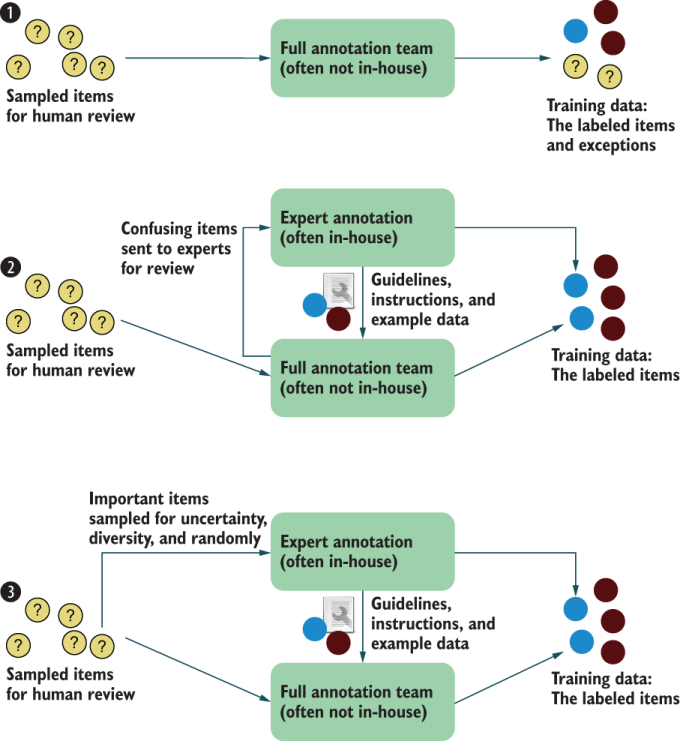
Compare workflows for routing difficult examples to experts and updating guidelines as data changes. section 7.2.4
Ambiguous image labels
An image may plausibly be labeled “Pedestrian” or “Cyclist,” while “Animal” and “Sign” are incorrect. Detailed guidelines might establish one correct interpretation for a particular image, but not every dataset permits one objective answer. For subjective tasks, capturing a diversity of valid judgments can be important; open-ended tasks may require more expert review. section 9.1
In-house annotations can also become human training examples for quality control. Even when model predictions are used as labels, human annotation processes, guidelines, and quality control are still needed to create evaluation data. section 7.2.4 section 9.3