Language modeling learns the statistical structure of language so systems can predict or generate text. Its practical value depends on more than producing plausible sentences: language carries ambiguity, lost context, and meaning that does not necessarily correspond to reality. section 2.0 section 2.5
A useful mental model treats language as an abstraction layered between human thoughts and machine-readable representations. Each abstraction—from meaning to language, tokens, embeddings, and model computations—can discard information or introduce failure. section 2.1
Language-modeling approaches have evolved by adding capabilities for representing structure and context:
- N-grams and naive Bayes classifiers provide early statistical approaches. section 2.0
- MLPs, recurrent neural networks, and LSTMs extend modeling with neural representations and sequential processing. section 2.0
- Transformers use attention to handle larger context windows and support modern encoder, decoder, and combined architectures. section 2.5
- Tokenization contributes morphology, while embeddings improve semantic approximations; pragmatics generally requires additional engineering. section 2.5
From impressive demo to dependable product
IBM Watson defeated elite Jeopardy contestants and attracted commercial interest, including healthcare applications, but those applications failed to become profitable. The contrast illustrates the central production lesson: a prototype needs to work once, while a product must work reliably for many users amid language’s nuances. section 1.3
Figure 2.1 We compare cognitive layers of abstraction to programming layers of abstraction down to the logical binary abstraction. Python doesn’t come from C, nor does it compile into C. Python is, however, another layer of abstraction distant from binary. Language follows a similar path. Each layer of abstraction creates a potential point of failure. There are also several layers of abstraction to creating a model, and each is important in seeing the full path from our feelings to a working model.
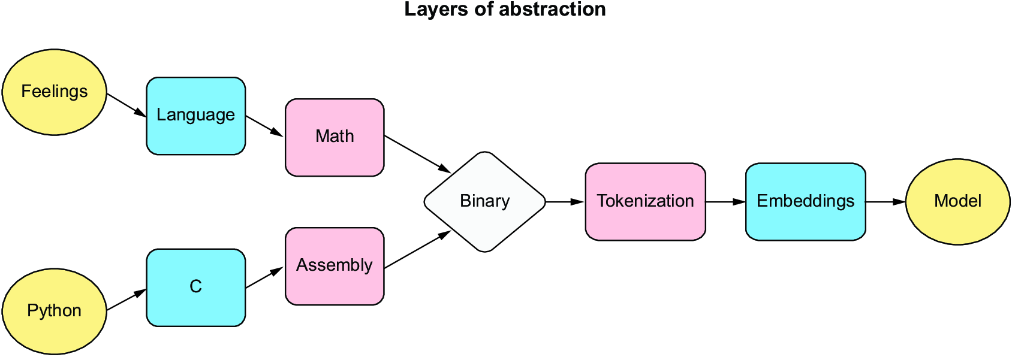
Trace the parallel abstraction layers from human cognition through language and programming representations to binary, and identify where information loss or failure can arise. section 2.1



